Original Translation by J. J. Jones, 1949. Edited by Upāsikā Jigon, 2026. Translated from the Śrīkinnarījātaka, from Mahāvastu Avadāna 94-115.
The Translation
The bhikṣus said to the Bhagavān, “Yaśodharā was won by the Bhagavān after much fatigue.” The Bhagavān replied, “This was not the first occasion that I won Yaśodharā after much fatigue. There was another occasion also on which she was won by me after great fatigue, great patience and great exertion.” The bhikṣus asked, “Was there another occasion, Lord?” The Bhagavān replied, “Yes, O bhikṣus.”
Once upon a time, O bhikṣus , long ago, in Hastināpura there reigned a king named Subāhu. He was virtuous, majestic, powerful, wealthy, with many beasts of burden, and was lord over sixty-thousand cities. He had one son, a boy named Sudhanu who was amiable, beautiful, comely, virtuous, distinguished, accomplished and dutiful to his mother and father. He had been appointed heir to the throne by his father Subāhu, and with the ministers he supervised the government of his father’s thousands of cities.
King Subāhu, relinquishing the burden of his kingly duties, resorted to the pleasant terrace of his palace and sat down to take his ease. Now King Subāhu had as neighbour a king named Sucandrima, who was of the same age as he, and with whom he had close associations. This king ruled in Siṃhapura, and he was virtuous, majestic, powerful, and wealthy, possessing many beasts of burden.
King Sucandrima was making preparations for a great sacrifice. He said, “I shall offer a sacrifice with every kind of animal.” He issued orders to all the hunters in his domain, saying, “I shall offer a sacrifice with every kind of animal. So bring together all living things that live on land, those without feet, those with two, those with four and those with many.” He gave instructions to the fishermen also, bidding them supply all living things that lived in the water.
The wishes of devas are fulfilled by their thoughts, those of kings by the word of command, those of rich men are speedily fulfilled, and those of the poor are fulfilled by their labours.
At the king’s word of command the hunters and fishermen brought together all living things on land and in the water.
They constructed a large enclosure in which they shut in all the land animals. They collected the fishes and confined them in a tank. Every kind of living thing was there, except that there was no Kiṃnarī.
And when the sacrificial enclosure of King Sucandrima had been put in readiness with all things necessary, the king bathed his head, took off his clothes and went naked to the upper terrace. There with the incense of sweet-smelling flowers he offered worship. With joined hands raised he bowed to the four quarters and said, “I invite to the sacrificial enclosure all ṛṣis of the Bhagavān who are masters of the four meditations, of the five branches of the higher knowledge, who are great in magic and can travel through the air, wherever they may be, in the east, south, west or north.”
Then all the ṛṣis who had achieved the four meditations, were masters of the five branches of the higher knowledge, were great in magic and had great power, paid heed to the summons and by their magic power came to the sacred enclosure flying through the air. And King Sucandrima, seeing these ṛṣis come to the sacrificial enclosure, in his joy and gladness and satisfaction bowed at their feet and said to them, “Let your lordships survey the sacrificial enclosure and see if it is complete or not.” The ṛṣis did so, and said to the king, “Your majesty, the sacrificial enclosure is entirely complete, except for one thing lacking.” The king asked, “What is lacking?” The ṛṣis replied, “Sire, it lacks a Kiṃnarī.”
Then King Sucandrima said to the hunters, “These worthy ṛṣis say that the sacrificial enclosure lacks a Kiṃnarī. So go, and make every effort to bring me a Kiṃnarī.” And the hunter who was pre-eminent among the thousands of hunters for energy, strength and courage was urged by the whole crowd of hunters. “You,” said they, “are competent, and you can bring back a Kiṃnarī.” And that hunter, thus urged by the other hunters and by King Sucandrima, took his bow and quiver of arrows and went up into Mt. Himavat.
There in Mt. Himavat he saw a ṛṣi’s pleasant retreat, which was well supplied with roots, leaves and fruits.
He approached the ṛṣi, bowed at his feet and remained standing. The ṛṣi bid him welcome, saying, “You are welcome. Pray sit down on this couch.” The ṛṣi talked pleasantly to the hunter, and, as was the custom of ṛṣis, offered him fruit and water. And the hunter ate the fruit, drank the water and sat down.
While he was in the ṛṣi’s presence the hunter heard such sweet singing as he had never heard before. He asked the ṛṣi, “Sir, whose is this pleasant song? Is it that of one of the deva or nāga maidens?” The ṛṣi replied, “This is not the singing of deva maidens nor of nāga maidens, but of the Kiṃnarīs.”
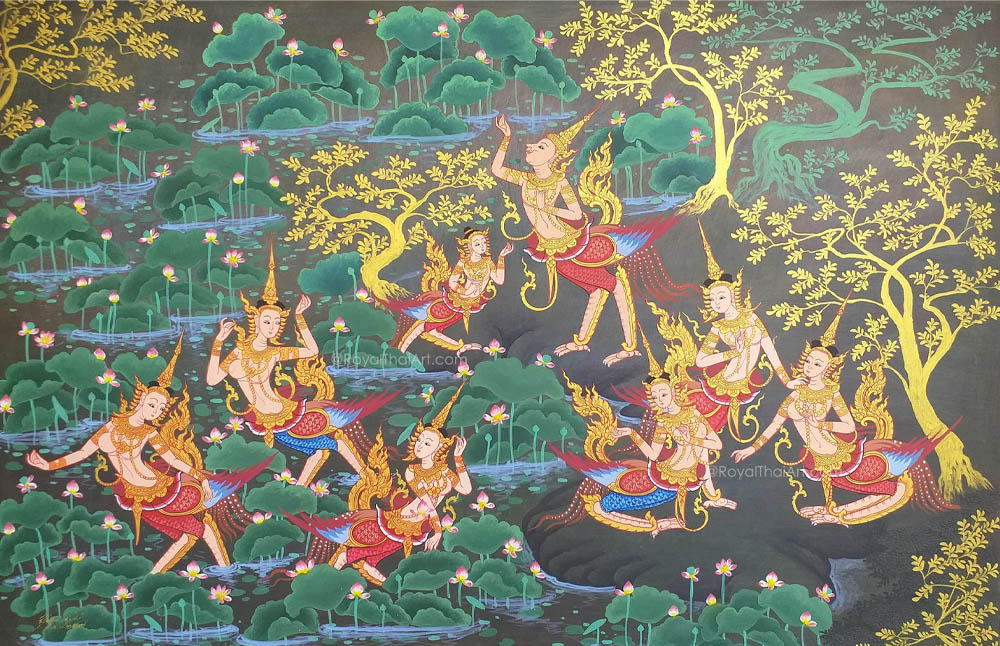
Then the hunter questioned the ṛṣi, “Sir,” said he, “I hear the singing, but I do not see the singers. Where are they singing?” The ṛṣi replied, “On the northern side of this retreat there is a large lotus-pond where there are at all seasons sweet smelling lotuses of every colour. Thither the daughter of Druma, king of the Kiṃnara, named Manoharā, is wont to go from Mt. Kailāśa to disport at the lotus-pond, accompanied by many Kiṃnaras and Kiṃnarīs.”
The astute hunter artfully questioned the ṛṣi. “Sir,” said he, “I have heard that there are some human beings who play and disport with the Kiṃnarīs. How have the Kiṃnarīs got into the power of those humans?” The ṛṣi replied, “They are bound by a word of truth, and they cannot disappear.” The good-natured ṛṣi told all this thoughtlessly, and he did not suspect that the hunter was after a Kiṃnarī.
Then the hunter having saluted the ṛṣi proceeded to the lotus-pond where the daughter of Druma, king of the Kiṃnaras, was disporting. And the Kiṃnarīs, being absorbed in their singing and playing of the pipes, did not observe the hunter. Manoharā was outstanding there for beauty and voice. Standing near enough for her to hear him the hunter bound Manoharā with this word of truth:
You are the glorious daughter of King Druma, King of Kiṃnaras. By this spell stand still; you are bound, Kiṃnarī.
As you are the daughter of King Druma, brought up by King Druma, by this spell, good Manoharā, do not move a step.
Thus Manoharā was caught by the hunter by means of a word of truth, and she had not the power of disappearing. But the other Kiṃnaras and Kiṃnarīs all disappeared.
The hunter took Manoharā to Siṃhapura, where she was put in the sacrificial enclosure. When King Sucandrima as well as the large crowd, saw the Kiṃnarī, he was well pleased with the hunter, who received a rich reward.
Bound in fetters Manoharā was thus led to Sucandrima’s city of Siṃhapura, which was become a city of brāhmins, and taken to the sacrificial enclosure.
When King Sucandrima had got everything completely ready for the sacrifice, he sent a messenger to King Subāhu at Hastināpura, saying, “I am performing a great sacrifice with every kind of animal. Come and enjoy yourself.” King Subāhu, however, sent his son, saying to him, “Go to Siṃhapura. King Sucandrima is going to perform a great sacrifice. Go and enjoy it.”
Prince Sudhanu came to Siṃhapura, as well as several hundred other kings. Among them all Prince Sudhanu was pre-eminent for beauty, splendour, escort, and perfume. He entered the sacrificial enclosure escorted by several hundred kings. In the sacrificial enclosure he saw many thousands of living things, both land and water animals. He saw the Kiṃnarī, too.
As soon as Prince Sudhanu saw the Kiṃnarī he conceived a noble love for her, and she conceived a love for Sudhanu. As the Bhagavān said in a verse in one of his discourses:
By living together in the past and by kindness in the present, so this love is born, as a lotus is born in water.
So they fell in love with each other at first sight.
Prince Sudhanu asked King Sucandrima, “Why are all these thousands of living beings confined in the sacrificial enclosure?” The king replied, “With these I am offering a sacrifice; there will be plenty to eat, both of solid and of soft food.”
The prince asked “What profit is there in this sacrifice? What good will come of it? What good will come of a sacrifice that consists in slaughtering all these living things?” The king replied, “All these living beings who will be slain in this sacrifice will go to heaven. And as for me, I shall be reborn in heaven a number of times equal to the number of beings I shall slay in this sacrifice.”
The prince replied, “Your majesty, is not this a wrong view? For the highest rule of Dharma is not to cause harm. To take life is not dharma; to abstain from taking life is Dharma. To steal is Adharma; to abstain from stealing is Dharma. To go astray after sensual pleasures is Adharma; to abstain from going astray after sensual pleasures is Dharma. To drink intoxicating liquor and spirits is Adharma; to abstain from drinking intoxicating liquor and spirits is Dharma. To tell lies is Adharma; to abstain from telling lies is Dharma. To slander is Adharma; to abstain from slander is Dharma. Idle chatter is Adharma; to abstain from idle chatter is Dharma. Ignorance is Adharma; to abstain from being ignorant is Dharma. Ill-will is Adharma; to abstain from ill-will is Dharma. Wrong view is Adharma; right view is Dharma. The path of the ten right actions is Dharma. Your majesty, those who follow the path of the ten wrong actions are reborn in hell. Those who follow the path of the ten right actions are reborn in heaven. In the present instance the path taken by your majesty is not the path to heaven; it is the path that leads to hell.”
When King Sucandrima heard this exposition of the Dharma by Prince Sudhanu, he and all the other kings, as well as the great crowd, were pleased. And after hearing it, he let out all the living things, both land and water animals.
Manoharā, the Kiṃnarī, clung to Prince Sudhanu. She had no thought for the world of the Kiṃnaras because of her love for Sudhanu. And Sudhanu, in his turn, no longer had any thought for the delights of sport, because of his love for Manoharā.
Following Prince Sudhanu’s instructions King Sucandrima offered an unobjectionable, blameless sacrifice. Several thousand recluses, brāhmans, beggars and wayfarers were given food and drink, and clothed with garments. When the sacrifice was over, Prince Sudhanu with Manoharā mounted on an elephant’s back, and in great pomp, circumstance and splendour left Siṃhapura for Hastināpura.
When the young prince entered the city of Hastināpura it was gaily bedecked. Awnings were stretched over it. It was carpeted with bright cloth, draped with festoons of fine cloth; it was sprinkled and swept, made fragrant with incense and strewn with flowers. In all directions there were mimes, dancers, athletes, wrestlers, minstrels and drummers. So Prince Sudhanu, along with Manoharā, in great pomp and circumstance entered Hastināpura mounted on an elephant’s back. The prince dismissed all the royal maidens and amused himself with Manoharā alone. The thousand duties in King Subāhu’s sixty-thousand cities were neglected; several thousand tasks were abandoned.
The citizens and provincials made representations to King Subāhu. “Your majesty,” said they, “Prince Sudhanu is completely bemused by Manoharā, the Kiṃnarī. He does not administer the affairs entrusted to him. His duties as a ruler are neglected and several thousand tasks in the sixty thousand cities are abandoned.”
King Subāhu called Prince Sudhanu to him and said to him, “My son, my subjects are protesting loudly. They say that you do not attend to affairs as you did before, but that you spend your time bemused with Manoharā. My son, send this Kiṃnarī away. Let her go.”
But the prince, caught in the toils of his desire for Manoharā, would not let her go. Again and again did his father say to him, “My son, send this Kiṃnarī away. I will have royal maidens brought to you instead, as many as you will say.” The prince, however, in spite of repeated appeals by his father refused to send her away.
The ministers, too, repeatedly reported to King Subāhu, saying, “Your majesty, Prince Sudhanu bemused by the Kiṃnarī Manoharā does not perform his duties as ruler, and many royal duties are neglected.” The king ordered his ministers to place the prince in confinement, and the ministers at the king’s command did so. But with the prince in confinement the household lost its good fortune, and all its luck vanished. King Subāhu himself bade Manoharā go to Nirati, the city of the Kiṃnaras. “Manoharā,” said he, “go. I bid you, go where the pleasant and cool woodlands are, to the presence of your mother and father.”
Then, arrayed in all her finery, she came out of the palace. And as she did so several thousands of Sudhanu’s women wept in sorrow for Manoharā. In Hastināpura the citizens had come together in a solid mass, on the left hand and on the right, as Manoharā made her way out of the city. On the left hand and on the right she was saluted by thousands of outstretched hands, and honoured with fragrant garlands by thousands of women and escorted by a great crowd of people. Having at length left Hastināpura she dismissed the crowd, and, turning towards the north where Mt. Himavat, King of Mountains, stood, she made her way thither. But she turned back now and then to look down towards Hastināpura and Sudhanu.
Now up there in Mt. Himavat, on the banks of the Śatadru River, two hunters happened to be hunting for deer. One hunter was named Utpalaka, the other Mālaka. From afar they saw Manoharā the Kiṃnarī coming, decked out in all her finery, richly anointed, and carrying unwithered fragrant garlands. But ever and again she kept turning to gaze backwards. They recognised her as a Kiṃnarī, and bowing before her with their joined hands raised they asked her,
You go on and look round; you look round and go on. Why, lady, do you look round, and whither are you going?
Manoharā replied:—
I yearn for two things, my lord, and the home of the wild men. I look down towards Sudhanu, and yet I would fain get to Nirati.
Then the hunters said:—
Prince Sudhanu has women from among the Kurus and Pañcālas. He takes his joy with them; he will not remember you.
Manoharā replied:—
I can draw Sudhanu with a glance and a smile. Though one be grown as big as an elephant I’ll still have power to hold him.
She gave the hunters a finger-ring which she wore, worth a hundred-thousand pieces and a garland of tālīsa, saying, “If Prince Sudhanu comes after me looking for me, give him these tokens and greet him in my name. You are to say to him, ‘Return hence, you are on a difficult road beyond the haunts of men.’ For it is my destiny to live apart from men.”
When she had thus instructed the hunters, Manoharā crossed the Śatadru River without touching it even with the soles of her feet.
When King Subāhu learnt that Manoharā had gone he sent for Prince Sudhanu, who was embraced by his father and mother. “Son,” they told him, “think no more of the Kiṃnarī. You have a numerous harem, and I shall even get thousands of other women besides. With these divert, delight and amuse yourself. What is the Kiṃnarī to you? You are a human being.”
Thus did the king comfort the prince, and he gave orders to his ministers, saying, “Have the prince’s dwelling decorated.” To the women he gave instructions, saying, “See that you delight the prince well, so that he will no longer think of Manoharā.”
At the king’s command the prince’s house was so decorated that in every respect it could be styled a celestial mansion. In the seven entrance-halls jars of aromatic powders were placed, and unhusked grain and all the other things which are considered marks of good fortune in the world. Thousands of brāhmins were posted at the prince’s door, and another large number of people watched over the prince.
When his father had thus comforted the prince he dismissed him. “Go home,” said he, “do your act of worship, bathe and anoint yourself. Then, decked out with garlands and jewels, divert, enjoy and amuse yourself, and administer the royal affairs.” Having been thus instructed by his father Prince Sudhanu was dismissed.
After he had left the palace, with one devoted companion, Vasantaka, he went out from Hastināpura and turned his steps towards Mt. Himavat, King of Mountains, in quest of Manoharā. The prince gave no thought to his father’s sixty-thousand rich cities , the villages and provinces, and his spacious harem. So much did he grieve for Manoharā and remember her.
When he observed the king’s lamentation then did he renounce everything, and set out wearing garments that were unwashed and soiled.
He took with him one devoted and loving attendant, and turned his face towards the monarch of mountains; to the Himavat he wended his way.
Ere long he came to the pleasant mountain slopes of the Himavat, and there he espied the two hunters, Utpalaka and Mālaka.
He saw, too, the stream of Śatadru ever clear and limpid as crystal….
The Śatadru, with its pleasant and cool stream flowing gently, freshly and nobly along, rolled on between verdant banks. It could carry on army on its bosom.
Sudhanu said, “Hunters, did you see a woman of dusky complexion pass by, richly anointed, and carrying a fragrant unwithered garland?”
They replied, “She whom you seek went by a long time ago. She crossed the river, and by this time she has reached Mt. Himavat.
“She forewarned us, saying, ‘If a man, named Sudhanu, should come after me, O hunters, give him this token.
“‘Give him this finger-ring of mine and this garland of sweet-smelling tālīsa. He is my husband, lord and master.
“‘O hunters, greet my lord in my name. Bid him return to Hastināpura. For it is my destiny to live in continence apart from him
Joyfully he seized the garland and took hold of the ring, and said, “I’ll go to my death or to reunion with Manoharā.”
The two hunters answered Sudhanu, “Now,” said they, “go back from here. What woman in the city of Hastināpura could be undevoted to you?”
But this it was not in his heart to do, and he hearkened not to their words. He was determined to go in spite of all, and he crossed the great stream of Śatadru.
The hunters, left standing there, reflected, “The king will be sore vexed with us if we thus abandon Sudhanu in his perilous enterprise.”
So they, too, crossed the river, while herds of tigers, lions and elephants roared, and deer and birds followed its course, and red geese merrily cackled.
And immediately they crossed the great river as its waters flowed on delightfully to the accompaniment of the songs of geese and swans, the hissing of snakes and the cries of the Kiṃnaras.
Thus the prince, his attendant Vasantaka and the hunters Utpalaka and Mālaka, bent on catching up with Manoharā entered Mt. Himavat, King of Mountains, on foot. As for Manoharā she went on making garlands for herself from the flowers of many colours which grew along her way. The others, seeing the flowers she left behind, followed in her wake. Here the dusky lady had stopped to rest, and then gone on again. There she had sat down for a moment, as was proved by the heap of flowers. Here were fair spotless garlands which she had made, and here and there were seen the beautiful ear-rings of flowers which she had made.
They knew thus that the dusky lady had gone by, and so they went on. They saw ornaments of various kinds fallen on the path, and some hanging on the branches of trees. They saw other signs as well.
The farther they penetrated into Mt. Himavat the more numerous were the precious stones they saw. They saw mountains with peaks of suvarṇa; they saw mountains with peaks of rūpya. They saw smiths working in iron, copper and brass. They saw mountain peaks of yaśada; they saw mountains of añjana and mountains of manaśilā. They saw couples of Kiṃnaras disporting themselves. And many hundreds of other marvels and wonders did they see. In all directions could be heard the sound of Kiṃnaras singing, the roars of lions, tigers and bears, and the cries of various other wild beasts. They heard the cries of Yakṣas, Rākṣasas, Piśācas, and Kumbhāṇḍas. They saw hundreds of medicinal herbs of various kinds, and they saw siddhas.
As they proceeded on their way they espied the retreat of the Ṛṣi Kāśyapa, which was well supplied with plentiful roots, leaves, flowers and fruits, was shaded by thousands of trees and well watered. They entered the retreat, and there they saw the ṛṣi Kāśyapa, venerable and distinguished, seated with his attendants. They saluted the ṛṣi and his attendants, and stood before them.
The ṛṣi thought to himself, “This illustrious prince must needs be good and virtuous, seeing that he has come to this retreat. It is a place that is not easily reached.” He greeted the prince, saying, “Welcome, prince, pray be seated. Here are couches.” The prince and his companions sat down. The ṛṣi set before them fruits that were as sweet as pure honey, and water.
When the prince had eaten the fruits and drunk the water, the ṛṣi asked him, “On what business does the Well-to-do and prosperous prince come?”
The prince replied, “Sir, did you see a beautiful woman pass by?” The ṛṣi answered, “Yes, I saw her. She came and stayed in this retreat. Then she bowed at my feet and went on along the mountain slopes. So let your highness turn back from this retreat. It was an arduous toil for the prince to come even as far as this place. But what will it be like for him to go still farther on a path untrodden of men? Turn back therefore.” But the prince said, “Sir, I cannot turn back. By that same way by which Manoharā has gone will I go too.” The ṛṣi said: “The ways of Kiṃnarīs are different from the ways of men. Even birds cannot penetrate into the ways of the Kiṃnarīs. How much less can men? Birds, too, somehow come to this place. Where the Kiṃnaras go rejoicing and realise their life of joy, that place, O prince, is unapproachable to the footsteps of men. Therefore turn back from this retreat. Your father is lord of sixty-thousand cities. Should not the prince divert and amuse himself by taking part in noble means of enjoyment? He cannot go to this unapproachable place.” The prince, however, replied, “I’ll either die or see her.”
Now the ṛṣi was a highly gifted man, of great kindliness of heart, and compassionate. He thought to himself, “If the prince goes to this inaccessible place, he will certainly perish.” So he said, “Prince, for this night stay here in the hermitage until the monkeys come to this place. The leader of their herd is devoted to me, and constantly comes to make obeisance to me and bring me fruits sweet as fresh honey. I shall make a request of this king of the monkeys, and he will guide you to the city, called Nirati, of Druma, king of the Kiṃnaras.” The prince stayed for the night. When the dawn was breaking he heard a sound as of a lion running by. He asked the young companions of the ṛṣi, “Whom did I hear running by?” One of them replied “That was the sound of the king of monkeys running by. At this time of day he regularly brings fruits sweet as fresh honey, and running from thicket to thicket comes to bow at our master’s feet.”
The prince rose up eagerly and noted where the noise made by the running monkey came from. And then he saw the king of the monkeys come passing from one thicket to another.
The king of the monkeys came to the retreat, threw down in front of the ṛṣi the honey-sweet fruits he had brought, and sat down. The ṛṣi said to him, “O king of monkeys, do me a good turn.” The king of the monkeys replied, “I will, sir. Command me.” The ṛṣi said. “Conduct this prince and his three companions to the city, named Nirati, of the Kiṃnara King Druma.” The monkey replied, “I’ll do so.”
The king of monkeys, then, took the prince and his three companions on his back, and left the hermitage. Passing from mountain peak to mountain peak and from forest to forest, ere long he reached the city of Druma, king of the Kiṃnaras, on the summit of Mt. Kailāśa. And on the summit of Mt. Kailāśa he saw the city, named Nirati, of Druma, king of the Kiṃnaras.
This city was finely constructed entirely of gold. It was surrounded by a thousand parks, and by lotus-pools adorned with all the precious stones, having steps made of planks of beryl and ornamented with all the precious stones, and railings of the seven precious stones around them; they were covered with fragrant blue, red, yellow and white lotuses and enclosed in gem-studded banks. Boats gleaming with various jewels floated on them, bright as spring, and other various kinds of skiffs sailed on them as well. The city was embowered by thousands of woods full of variegated flowers, leaves and fruits, and beautified by the atimuktaka, campaka, vārṣika, the Arabian jasmine, the great-flowered jasmine, the double jasmine and the yūthika. Here and there they saw thousands of couples of Kiṃnaras disporting themselves. Some played on pipes and others on various other kinds of musical instruments, and others sang in sweet voices around Manoharā. Within the city could be heard the hundred sounds of musical instruments and the sweet strains of singing.
And then, as they stood there without the city of the king of the Kiṃnaras, in a grove, they saw a group of Kiṃnarīs, who were comely, beautiful, gaily adorned and splendidly arrayed, coming with golden pitchers in their hands to draw water at the pool where Sudhanu stood.
Sudhanu asked them, “What festival is on in the city, that there is such great rejoicing?” They replied, “To-day is no festival nor holiday. But the daughter, named Manoharā, of Druma, King of Kiṃnaras, who was enticed away by men, has after many years come back again. And at her coming Druma, the king of the Kiṃnaras, and all his city rejoice. Hence all this merry-making.”
Sudhanu asked, “Where is this water to be taken?” They replied, “Manoharā is going to have a bath so that the smell of men shall be removed from her.”
The prince put the finger-ring in the last pitcher, in such a way that it was not seen by the Kiṃnarīs.
Manoharā had her bath, and as she bathed the finger-ring fell out of the pitcher on to her lap. When she saw the finger-ring she recognised it. She thought to herself, “Prince Sudhanu has come to seek me. He was delicately brought up. How can he have got to this inaccessible place?”
Then in great haste she put on her clothes. Weeping and sobbing she threw herself at her parents’ feet and said to them, “He who in Jambudvīpa was my husband has come. He is named Sudhanu, and is a prince, the only son of King Subāhu.” But Druma, King of Kiṃnaras, did not believe her. “My daughter,” said he, “it is not possible for humans to come here.” Manoharā replied, “Not so, father, for he has manifestly come.” Druma, King of Kiṃnaras, asked, “Did you see him yourself, or did you hear of him from another?” She replied, “I have neither seen him myself nor have I heard of him from another. But as I was bathing Sudhanu’s finger-ring dropped into my lap.”
Druma, King of Kiṃnaras, called for the water-carriers and asked them, “When you had gone to fetch water, where did you see a man?” They replied, “Your majesty, we saw a comely and beautiful Kiṃnara youth with three companions on the edge of a lotus-pool.” He thought to himself, “This is evidently Manoharā’s prince. How was he able to come to this place?”
Then he asked his daughter, “Manoharā, shall I bid prince Sudhanu enter the palace?” She replied, “Yes, father. Let him enter. He has come hither because of his love for me, and on my account he is very much out of favour and respect with his father, at whose hands he suffered imprisonment and punishment. But he would never give me up. When prince Sudhanu was confined in his house by King Subāhu, I was sent away. As soon as he was released he set out after me.”
Druma, King of Kiṃnaras, gave orders to his ministers, saying, “Quickly have the city decorated, including the royal palace and the asuras’ lotus-pools. Have an awning stretched out and bright flowers strewn around; have the city draped with streamers of fine cloth; have it sprinkled and swept, strewn with garlands of flowers and drenched with sweetsmelling water. Let all my chief men in the city and army, with chariots beflagged and bannered, go out to meet my son-in-law.”
All the king’s commands were carried out by his ministers and a reception arranged with great pomp. Manoharā also, clothed in a costly mantle and splendidly adorned with all sorts of ornaments, went out to meet him, accompanied by several thousand Kiṃnaras and to the accompaniment of thousands of musical instruments. When she saw Sudhanu she bowed at his feet and touched them with her face and hair.
Thus with great splendour and pomp Sudhanu was led into the city of Druma, King of Kiṃnaras, and into the royal palace. There he was welcomed, embraced, and comforted by King Druma. “This city,” said the king to him, “which is all made of gold, encircled by thousands of parks, and infinitely fair, is yours. Here, with my daughter Manoharā, divert, enjoy and amuse yourself.”
Now when Sudhanu had lived in the city of the Kiṃnaras for many years, diverting, enjoying, and amusing himself, he began to feel a desire to return home. “Manoharā,” said he, “you know that I am the only son of my parents, dear to and beloved of them. Because of my love for you and without asking my parents’ leave, I abandoned everything and made a voluntary renunciation, and came here. And now it is many a year since I have come here to live. Therefore, tell your mother and father that I am going back to Hastināpura.”
Manoharā reported this to her parents. Druma, King of Kiṃnaras, asked Sudhanu, “Are you going back to your parents?” The prince replied, “If, sire, you approve, I shall go.” Druma said, “I will let you go.” Now the Yakṣas who were called Yambhakas were under the authority of the Kiṃnaras, and the king gave them orders, saying, “Conduct my son-in-law, his attendants, and Manoharā, to Hastināpura, and take with you an abundant supply of all kinds of precious stones.” And they lifted up Prince Sudhanu, his attendants, and Manoharā, as they were lying asleep, and bore them and an abundant supply of precious stones from the city of the Kiṃnaras. They carried them to Hastināpura, where they set them down in a royal park. At daybreak, Prince Sudhanu woke up and heard the roar of the dram and the noise of the people in Hastināpura. He asked himself, “How was I brought to Hastināpura?” Then he recognised the royal park, the bejewelled palanquins as though specially placed there, and Manoharā and his three companions, and the abundant treasure. He was glad to have come to his dear city.
King Subāhu had caused a very strenuous search to be made for the prince after he had left Hastināpura. And when he failed to find him he said, “My son must have died in his quest for Manoharā.” So the king had ordered funeral rites to be performed for the dead Prince Sudhanu. And all the people in the place had also thought that Sudhanu was dead.
Then the park-keepers hurried out of the city to hoist flags in the royal park by the main gate. And when they reached the park they saw Sudhanu, Manoharā and the three companions, the jewelled palanquins, and the great heap of precious stones. When they had seen all this they hurried back again and entered Hastināpura. The people asked “Is all well?” They replied, “All is well. For Prince Sudhanu has come back.” And the people were delighted to hear this.
The park-keepers proceeded to the royal palace and made their report to King Subāhu. “Your majesty,” said they, “all haū! Prince Sudhanu has come.” The king and all his court rejoiced on hearing this, and a generous reward was given to the park-keepers.
King Subāhu, his ministers and attendants, the queen, Sudhanu’s mother, and all the women of the court ran out to the park to see the prince. And all the citizens did so, too, when they heard of the arrival of Prince Sudhanu and Manoharā. There was a solid mass of people hurrying out from Hastināpura to the royal park to see the prince and Manoharā.
When Sudhanu saw his mother and father he bowed his head at their feet, and Manoharā, when she saw her parents-in-law, did likewise. The prince, with Subāhu his father, mounted a richly caparisoned elephant clothed in a net-work of gold, and with great royal pomp, splendour and magnificence entered Hastināpura.
Thus let all men, abandoning folly, be united with all those dear to them, as on this occasion Sudhanu was united with the Kiṃnarī.
The Bhagavān said, “It may be again, O bhikṣus, that you will think that at that time and on that occasion the prince named Sudhanu was somebody else. You must not think so. And why? I, O bhikṣus, at that time and on that occasion was the prince named Sudhanu.
It may be again, O bhikṣus, that you will think that at that time and on that occasion the king named Subāhu was somebody else. That, too, you must not think. And why? King Śuddhodana here, O bhikṣus, at that time and on that occasion was the king named Subāhu.
You may think that at that time and on that occasion the mother of Sudhanu was somebody else. You must not think that. And why? Queen Māyā here, O bhikṣus, at that time and on that occasion was Sudhanu’s mother.
It may be again, O bhikṣus, that you will think that at that time and on that occasion Sudhanu’s attendant named Vasantaka was somebody else. You must not think so. And why? Chandaka here, O bhikṣus, at that time and on that occasion was Sudhanu’s attendant.
You may think that at that time and on that occasion the hunter named Uppalaka was somebody else. You must not think so. Why? Rāhula here, O bhikṣus, was the hunter named Uppalaka.
You may think that at that time and on that occasion the hunter named Mālaka was somebody else.You must not think so. And why? The elder Ānanda here, O bhikṣus, at that time and on that occasion was the hunter named Mālaka.
You may think that at that time and on that occasion the ṛṣi named Kāśyapa was somebody else. You must not think so. Why? The elder Mahākāśyapa here, O bhikṣus, at that time and on that occasion was the ṛṣi of the Kāśyapan clan living in Mt. Himavat.
You may think that at that time and on that occasion the king of the monkeys in Mt. Himavat was somebody else. You must not think so. And why? Kaṇṭhaka here, O bhikṣus, the king of steeds, at that time and on that occasion was the King of Monkeys in Mt. Himavat.
You may think that the Kiṃnara king, named Druma, living on the summit of Mt. Kailāśa was somebody else. You must not think so. And why? The Śākyan Mahānāma here, O bhikṣus, at that time and on that occasion was the Kiṃnara King Druma.
You may think that at that time and on that occasion the mother of Manoharā was somebody else. You must not think so. And why? Yasodharā’s mother here, O bhikṣus, at that time and on that occasion was the mother of Manoharā.
You may think that at that time and on that occasion Manoharā was somebody else. You must not think so. And why? Yaśodharā here, O bhikṣus, at that time and on that occasion was Manoharā the Kiṃnarī.
Then, too, it was after much fatigue that I won her.
He whose eloquence is brilliant and profound, whose learning is great, who destroys the lusts and crushes his opponents, he, O bhikṣus, shines in his teaching of the Svayambhū as the full-orbed moon shines in the sky.
Here ends the Kiṃnarī Jātaka.
 Saddharmatā