Original translation by Robert Chalmers, 1895. Edited by Upāsikā Jigon, 2026. Translated from the Kulāvakajātaka, Ja 31, from PTS 1.203-1.207.
“Let all the forest’s nestlings be.” and so on—This story was told by the Śāsta while at Jetavana, to a bhikṣu who drank water without having strained it.
Tradition says that two young bhikṣus who were friends went from Śrāvastī into the country, and took up their abode in a pleasant spot. After staying there as long as they pleased, they departed and set out for Jetavana in order to see the Perfect Buddha.
One of them carried a strainer; the other had none; so both of them used the same strainer before drinking. One day they had a falling out. The owner of the strainer did not lend it to his companion, but strained and drank alone by himself.
As the other was not allowed the strainer, and as he could not endure his thirst, he drank water without straining it. In due course both reached Jetavana and with respectful obeisance to the Śāsta, they took their seats. After friendly words of greeting, He asked whence they had come.
“O Bhagavān,” said they, “we have been living in a hamlet in the Kośala country, whence we have come in order to see you.”
“I trust you have arrived as good friends as you started?” Said the Śāsta.
To this, said the bhikṣu without a strainer, “O Bhagavān, he fell out with me on the road and would not lend me his strainer.”,
To this, said the other, “O Bhagavān, he didn’t strain his water, but—wittingly—drank it down with all the living things it contained.”
“Is this report true, O bhikṣu, that you wittingly drank off water with all the living things it contained?” Asked the Śāsta.
“Yes, sir, I did drink unstrained water,” he replied.
“O bhikṣu, the wise and good of bygone days, when flying in rout along the Mahāsamudra in the days of their sovereignty over the City of the Devas, thought scorn to slay living-creatures in order to secure power for themselves. Rather, they turned their chariot back, sacrificing great glory in order to save the lives of the young of the Garuḍas.” And, so saying, He began to tell a story of the past.
Once on a time there was a king of Magadha reigning over Rājagrha in the laud of Magadha. And just as he who is now Śakra came to life in his preceding birth in the hamlet of Macala in the land of Magadha, even so was it in the selfsame hamlet that the Bodhisattva came to life in those days as a young noble. When the day for his naming came, he was named ‘Prince Magha,’ but when he grew up, it was as ‘Magha the young Brahmin’ that he was known. His parents took a wife for him from a family of equal rank with their own; and he, with a family of sons and daughters growing up round him, excelled in charity, and the keeping of the Five Precepts.
In that village there were just thirty families, and one day the men were standing in the middle of the village transacting the affairs of the village. There the Bodhisattva had kicked aside the dust from where he was standing, and was standing there in comfort, when up came another and took his stand there. Then the Bodhisattva made himself another comfortable standing-place,—only to have it taken from him like the first. Again and again the Bodhisattva began afresh until he had made comfortable standing-places for every man there.
Another time he put up a pavilion,—which later on he pulled down, building a hall with benches and a jar of water inside. Another time these thirty men were led by the Bodhisattva to become like-minded with himself; he established them in the Five Precepts, and thenceforth used to go about with them doing good works. And they too doing good works, always in the Bodhisattva’s company, used to get up early and sally forth, with razors, axes, and clubs in their hands.
With their clubs they used to roll out of the way all stones that lay on the four highways and other roads of the village; the trees that would strike against the axles of chariots, they cut down; rough places they made smooth; causeways they built, dug lakes, and built a hall; they shewed charity and kept the Precepts. In this wise did the body of the villagers generally abide by the Bodhisattva’s teachings and keep the Precepts.
To this, thought the village headman to himself, “When these men used to get drunk and commit murders and so forth, I used to make a lot of money out of them, not only on the price of their drinks but also by the fines and dues they paid. But now here’s this young brahmin Magha bent on making them keep the Precepts; he is putting a stop to murders and other crime.”
And in his rage he cried, “I’ll make them give up the Five Precepts!” And he repaired to the king, saying, “Sire, there is a band of robbers going about sacking villages and committing other villainies.”
When the king heard this, he bade the headman go and bring the men before him. And away went the man and hauled up as prisoners before the king every one of those thirty men, representing them to be the rascals. Without enquiry into their doings, the king commanded offhand that they should be trampled to death by the elephant.
Forthwith they made them lie down in the king’s courtyard and sent for the elephant. The Bodhisattva exhorted them, saying, “Bear in mind the Precepts! Maintain maitrī for the slanderer, the king and the elephant as yourselves.” And they did so.
Then the elephant was brought in to trample them to death. Yet lead him as they might, he would not approach them, but fled away trumpeting loudly. Elephant after elephant was brought up; but they all fled away like the first. Thinking that the men must have some drug about their persons, the king ordered them to be searched.
Search was made accordingly, but nothing was found; and so they told the king. “Then they must be muttering some mantra,” said the king; “ask them whether they have got a mantra to mutter.”
The question being put to them, the Bodhisattva said they had got a mantra. And this the king’s people told his majesty. So the king had them all summoned to his presence and said, “Tell me your mantra.”
The Bodhisattva made answer, “Sire, we have no other mantra than this, that not a man among the whole thirty of us destroys life, or takes what is not given, or misconducts himself, or lies; we drink no strong drink; we abound in maitrī; we shew charity; we level the roads, dig lakes, and build a public hall; this is our mantra, our paritrāṇa, and our rākṣā.”
Well-pleased with them, the king gave them all the wealth in the slanderer’s house and made the slanderer their slave; and he gave them the elephant and the village to boot.
Thenceforward, doing good works to their hearts’ content, they sent for a carpenter and caused him to put up a large hall at the meeting of the four highways; but as they had lost all desire for women, they would not let any woman share in their good work.
Now in those days there were four women in the Bodhisattva’s house, whose names were Sudharmā, Citrā, Nandā, and Sujā. Of these Sudharmā, finding herself alone with the carpenter, gave him a douceur, saying,—“O bhikṣu, contrive to make me the principal person in connexion with this hall.”
“Very good,” said he. And before doing any other work on the building, he had some pinnacle-wood dried, which he fashioned and bored and made into a finished pinnacle. This he wrapped up in a cloth and laid aside. When the hall was finished, and it was time to put on the pinnacle, he exclaimed, “Alas, my masters, there’s one thing we have not made.”
The other replied,“What’s that?”
To this, said he, “Why, we ought to have a pinnacle.”
The other replied, “All right, let one be got.”
He replied, “But it can’t be made out of green wood; we ought to have a pinnacle which had been cut some time ago, and fashioned, and bored, and laid by.”
The other replied, “Well, what is to be done now?”
He replied, “Why, have a look round to see if anybody has got such a thing in his house as a ready-made pinnacle for sale.”
As they. looked round accordingly, they found one in the house of Sudharmā, but could not buy it of her for any money. “If you will make me a partner in the good work,” said she, “I will give it you for nothing.”
“No,” was the reply, “we do not let women have a share in the good work.”
Then said the carpenter to them, “My masters, what is this you say? Save the Realm of Brahma, there is no place from which women are excluded. Take the pinnacle, and our work will be complete.”
Consenting, they took the pinnacle and completed their hall. They had benches put up, and jars of water set inside, providing also a constant supply of boiled rice. Round the hall they built a wall with a gate, strewing the space inside the wall with sand and planting a row of fan-palms outside. Citrā too caused a garden to be laid out at this spot, and not a flowering or fruit-bearing tree could be named which did not grow there. Nandā, too, caused a lake to be dug in the same place, covered over with the five kinds of lotuses, beautiful to behold. Sujā did nothing at all.
The Bodhisattva fulfilled these seven injunctions,—to cherish one’s mother, to cherish one’s father, to honour one’s elders, to speak truth, to avoid harsh speech, to eschew slander, and to shun miserliness—
Whoso supports his parents, honours age,
Is gentle, friendly-spoken, slandering not,
Unchurlish, truthful, lord—not slave—of wrath,
—Him e’en the Thirty Three shall hail as Good.
Such was the praiseworthy state to which he grew, and at his life’s close he passed away to be reborn in the Realm of the Thirty-three as Śakra, King of Devas; and there too were his friends reborn.
In those days there were Asuras dwelling in the Realm of the Thirty-three. To thi, said Śakra, King of Devas, “What good to us is a kingdom which others share?” So he made the Asuras drink the liquor of the Devas, and when they were drunken, he had them hurled by the feet on to the steeps of Mount Sumeru.
They tumbled right down to ‘The Asura Realm,’ as it is called,—a region on the lowest level of Mount Sumeru, equal in extent to the Realm of the Thirty-three. Here grows a tree, resembling the Pārijātaka Tree of the Devas, which lasts for one kalpa and is called the Citrāpāṭalī. The blossoms of this tree shewed them at once that this was not the Realm of Devas, for there the Pārijātaka blooms. So they cried, “Old Śakra has made us drunk and cast us into the Mahāsamudra, seizing on our heavenly city!”
“Come!” they shouted, “let us win back our own realm from him by force of arms.” And up the sides of Sumeru they climbed, like ants up a pillar.
Hearing the alarm given that the Asuras were up, Śakra went out into the Mahāsamudra to give them battle, but being worsted in the fight turned and fled away along crest after crest of the southern samudra in his ‘Chariot of Victory,’ which was a hundred and fifty yojanas long.
Now as his chariot sped along the samudra, it came to the Forest of the Kūṭaśālmalī Trees. Along the track of the chariot these mighty trees were mowed down like so many tālas, and fell into the samudra. And as the young of the Garuḍas hurtled through the samudra, loud were their shrieks.
To this, said Śakra to Mātali, his charioteer, “Mātali, my friend, what manner of noise is this? How heartrending it sounds.”
To this, Mātali replied, “Sire, it is the united cry of the young Garuḍas in the agony of their fear, as their forest is uprooted by the rush of your chariot.”
To this, said the Mahāsattva, “Let them not be troubled because of me, friend, O Mātali. Let us not, for empire’s sake, so act as to destroy life. Rather will I, for their sake, give my life as a sacrifice to the Asuras. Turn the chariot back!”
And so saying, he repeated this stanza:
“Let all the forest’s nestlings, O Mātali,
Escape our all-devouring chariot.
I offer up, a willing sacrifice,
My life to yonder Asuras; these poor birds
Shall not, through me, from out their nests be torn.”
At these words, Mātali, the charioteer, turned the chariot rightwards, and made for the Realm of Devas by another route. But the moment the Asuras saw him begin to turn his chariot round, they cried out that the Śakras of other the worlds were surely coming up; “it must be his reinforcements which make him turn his chariot back again!”
Trembling for their lives, they all ran away and never stopped till they came to the Asura Realm. And Śakra entering heaven, stood in the midst of his city, girt round by a celestial host of his own and of the Brahma’s own. And at that moment through the riven earth there rose up the ‘Palace of Victory,’ (Vaijayanta) some thousand yojanas high,—so-called because it arose in the hour of victory.
Then, to prevent the Asuras from coming back again, Śakra had guards set in five places,—concerning which it has been said—
Impregnable both cities stand! between,
In fivefold guard, watch the Nāgas,
Garuḍas,
Kumbhāṇḍas, Yakṣas, and the Four Heavenly Kings!
But when Sakka was enjoying as King of Devas the glory of his heaven, safely warded by his sentinels at these five posts, Sudharmā died and was reborn as a handmaiden of here Śakra once more. And the effect of her gift of the pinnacle was that there arose for her a mansion—named ‘Sudharmā’—studded with heavenly jewels, five hundred yojanas high, where, under a white heavenly canopy of royal state, sat Śakra, King of Devas, ruling men and Devas.
Citrā, too, died, and was once more born as a handmaiden of here Śakra; and the effect of her action in respect of the garden was such that there arose a garden called ‘Citralatāvana Grove.’
Nandā, too, died and was reborn once more as one of here Śakra’s handmaidens; and the fruit of her lake was that there arose a lake called ‘Nandā’ after her.
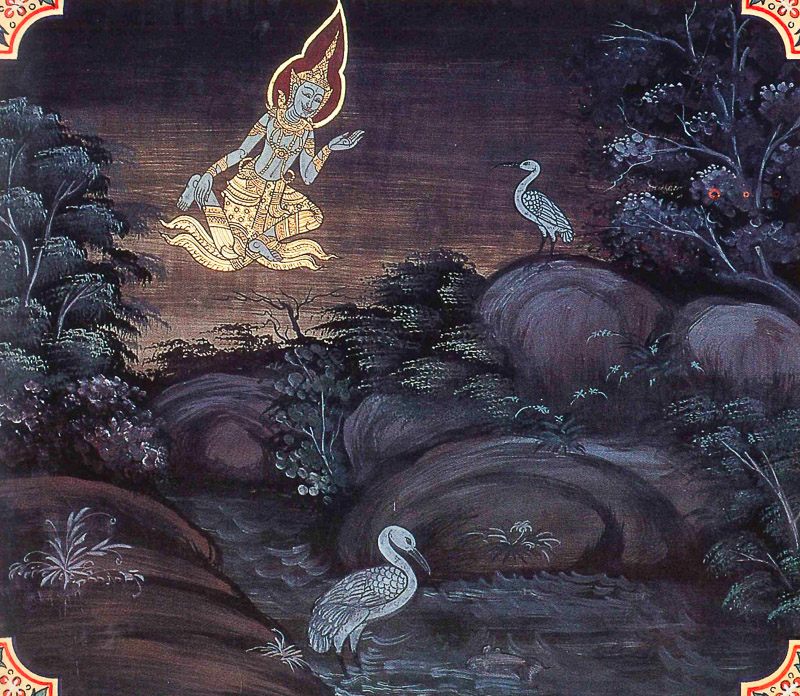
But Sujā, having performed no act of merit, was reborn as a crane in a grotto in the forest.
“There’s no sign of our Sujā,” said Śakra to himself; “I wonder where she has been reborn.” And as he considered the matter, he discovered her whereabouts. So he paid her a visit, and bringing her back with him to heaven shewed her the delightful city of the Devas, the Hall of Sudharmā, Citralatāvana Grove, and the Lake called Nandā.
“These three,” said Śakra, “have been reborn as my handmaidens by reason of the good works they did; but you, having done no good work, have been reborn in the animal realm. Henceforth keep the Precepts.”
And having exhorted her thus, and confirmed her in the Five Precepts, he took her back and let her go free. And thenceforth she did keep the Precepts.
A short time afterwards, being curious to know whether she really was able to keep the Precepts, Śakra went and lay down before her in the shape of a fish. Thinking the fish were dead, the crane seized it by the head. The fish then wagged its tail. “Why, I do believe it’s alive,” said the crane, and let the fish go. “Very good, very good,” said Śakra; “you will be able to keep the Precepts.” And so saying he went away.
Dying as a crane, Sujā was reborn into the family of a potter in Vārāṇasī. Wondering where she had got to, and at last discovering her whereabouts, Śakra, disguised himself as an old man, filled a cart with cucumbers of solid gold and sat in the middle of the village, crying, “Buy my cucumbers! buy my cucumbers!”
Folk came to him and asked for them.“I only part with them to such as keep the Precepts,” said he, “do you keep them?”
“We don’t know what you mean by your ‘Precepts’; sell us the cucumbers.” They cried.
“No; I don’t want money for my cucumbers. I give them away,—but only to those that keep the Precepts!”
“Who is this wag?” said the folk as they turned away.
Hearing of this, Sujā thought to herself that the cucumbers must have been brought for her, and accordingly went and asked for some.
“Do you keep the Precepts, madam?” said he.
“Yes, I do,” she replied.
“It was for you alone that I brought these here,” said he, and leaving cucumbers, cart and all at her door he departed.
Continuing all her life long to keep the Precepts, Sujā after her death was reborn the daughter of the Asura king Vipracitra, and for her goodness was rewarded with the gift of great beauty. When she grew up, her father mustered the Asuras together to give his daughter her pick of them for a husband. And Śakra, who had searched and found out her whereabouts, donned the shape of an Asura, and came down, saying to himself, “If Sujā chooses a husband really after her own heart, I shall be he.”
Sujā was arrayed and brought forth to the place of assembly, where she was bidden to select a husband after her own heart. Looking round and observing Śakra, she was moved by her love for him in a bygone existence to choose him for her husband. Śakra carried her off to the city of the devas and made her the chief of twenty-five millions of dancing-girls. And when his term of life ended, he passed away to fare according to his merit.
His lesson ended, the Śāsta rebuked that bhikṣu in these words, “Thus, O bhikṣu, the wise and good of bygone days when they were rulers of the Devas, forbore, even at the sacrifice of their own lives, to be guilty of slaughter. And can you, who have devoted yourself to so saving a creed, drink unstrained water with all the living creatures it contains?” And he chewed the connexion and identified the Birth, by saying, “Ānanda was then Mātali the charioteer, and I Śakra.”
Thus ends the Kulāvaka Jātaka.
 Saddharmatā