English translation by Upāsikā Jigon (慈嚴), Australia, 2026.
Chinese text accessed within the Taisho Tripitaka (T277).
The Sūtra

佛說觀普賢菩薩行法經
The Buddha Expounds the Samantabhadrabodhisattvacaryādhyāna Sūtra
宋元嘉年曇無蜜多於楊州譯
Song Dynasty, During the Reign of Yuangjia (424-453 C.E.), Translated by Dharmamitra, within the the Yangzhou Province.
[0389b28] 如是我聞:
Thus have I heard:
[0389b28] 一時佛在毘舍離國大林精舍重閣講堂,告諸比丘:「却後三月我當般涅槃。」
At one time the Buddha, while dwelling in the Kingdom of Vaiśāli, within the Kūṭāgāraśālā of the Mahāvāna Vihāra, addressed all of the bhikṣus:
“Three months from now, I shall pass into parinirvāṇa.”
[0389b29] 尊者阿難即從座起,整衣服,叉手合掌,遶佛三匝為佛作禮,胡跪合掌,諦觀如來,目不暫捨。長老摩訶迦葉、彌勒菩薩摩訶薩亦從座起,合掌作禮,瞻仰尊顏。
The Sthavira Ānanda immediately arose from his seat, adjusted his robes, placed his hands together in añjali, circumambulated the Buddha three times while keeping Him on his right, paid obeisance unto the Buddha, and kneeling down on his right knee with hands together in añjali, closely contemplated the Tathāgata with eyes unblinking. The Āyuṣman Mahākāśyapa and Maitreya Bodhisattva Mahāsattva arose from their seats, placed their palms together, and paid obeisance, revering the countenance of the Bhagavān.
[0389c04] 時三大士異口同音而白佛言:「世尊!如來滅後,云何眾生起菩薩心、修行大乘方等經典、正念思惟一實境界?云何不失無上菩提之心?云何復當不斷煩惱、不離五欲、得淨諸根、滅除諸罪?父母所生清淨常眼,不斷五欲而能得見諸障外事?」
At that time, these three mahāsattvas with different words but the same voice spoke to the Buddha, saying:
“Bhagavān! After the Tathāgata’s extinction, how should sentient beings arouse bodhicitta, cultivate the practices of the Mahāyāna Vaipulya scriptures, and with correct smṛti, reflect upon the ālambana of the One Truth? How shall one not lose the mind of anuttarasamyaksaṃbodhi? How, furthermore, shall one who does not eliminate the kleśas, while not separating from the five desires, still attain the purity of all the sense-fields, extinguish and eliminate the various transgressions? [How does one] purify these mundane eyes born of one’s father and mother without separating from the five desires, and still yet be able to attain vision beyond all the hindrances of external dharmas?”
[0389c09] 佛告阿難:「諦聽諦聽,善思念之。如來昔在耆闍崛山及餘住處,已廣分別一實之道;今於此處,為未來世諸眾生等,欲行大乘無上法者,欲學普賢行。普賢行者,我今當說其憶念法。若見普賢及不見者除却罪數,今為汝等當廣分別。
The Buddha addressed Ānanda:
“Listen carefully, listen closely, and apply your minds well. The Tathāgata, has in the past, on Mt. Gṛdhrakūṭa, and in all of the other abodes, extensively given details on the Path of the One Truth; now again, I shall serve all future sentient beings who desire to practise the Mahāyāna’s unsurpassed Dharma, and who desire to awaken to the practices of Samantabhadra. These are the practices of Samantabhadra, and it is the Dharmānusmṛti of which I shall now explain. Whether one sees Samantabhadra or not, one will eliminate differing numbers of transgressions, of which I shall now explain to you in great detail.”
[0389c15] 「阿難!普賢菩薩乃生東方淨妙國土,其國土相,《法華經》中已廣分別,我今於此略而解說。
“Ānanda! Samantabhadra Bodhisattva was born within the Viśuddhādbhutakṣetra of the Eastern Direction, the characteristics of that land have already been extensively described within the Dharma Flower Sūtra, so I shall shall now, in this place, omit this explanation.”
[0389c17] 「阿難!若比丘、比丘尼、優婆塞、優婆夷、天龍八部、一切眾生誦大乘經者、修大乘者、發大乘意者、樂見普賢菩薩色身者、樂見多寶佛塔者、樂見釋迦牟尼佛及分身諸佛者、樂得六根清淨者,當學是觀。此觀功德,除諸障礙、見上妙色,不入三昧但誦持故,專心修習,心心相次,不離大乘,一日至三七日得見普賢;有重障者,七七日盡然後得見;復有重者一生得見、復有重者二生得見、復有重者三生得見;如是種種業報不同,是故異說。
“Ānanda! If a bhikṣu, bhikṣunī, upāsaka, upāsikā, deva, nāga, any of the eight groups of divine beings, any and all sentient beings who recite the Mahāyāna sūtras, who cultivate the Mahāyāna, who have aroused the intent of the Mahāyāna, who would joyfully view the rūpakāya of Samantabhadra Bodhisattva, who would joyfully view the Stūpa of the Buddha Prabhūtaratna, who would joyfully view Śākyamuni Buddha and His various partial-nirmāṇakāyas Buddhas, and who would joyfully obtain the purification of the six sense organs, then such beings ought to study this contemplation. Thus the merit of this contemplation will eliminate all of the kleśas, to see the above saṃbhogakāyas, and without entering samādhi but only reciting and single-mindedly cultivating this practise — so that in each successive kṣaṇa not be separated from the Mahāyāna — then one will, in one day or three by seven days, obtain a vision of Samantabhadra. However, if one has heavy hindrances, then after seven by seven days one will attain a vision. If they are even heavier then one will attain a vision within a single lifetime, and if they are heavier yet, then one will attain a vision in two life-times, if they are even heavier then one will attain a vision within three life-times. And so, as there are differing levels of differing kinds of karmic retribution, which are each dissimilar, these are hence expounded differently.
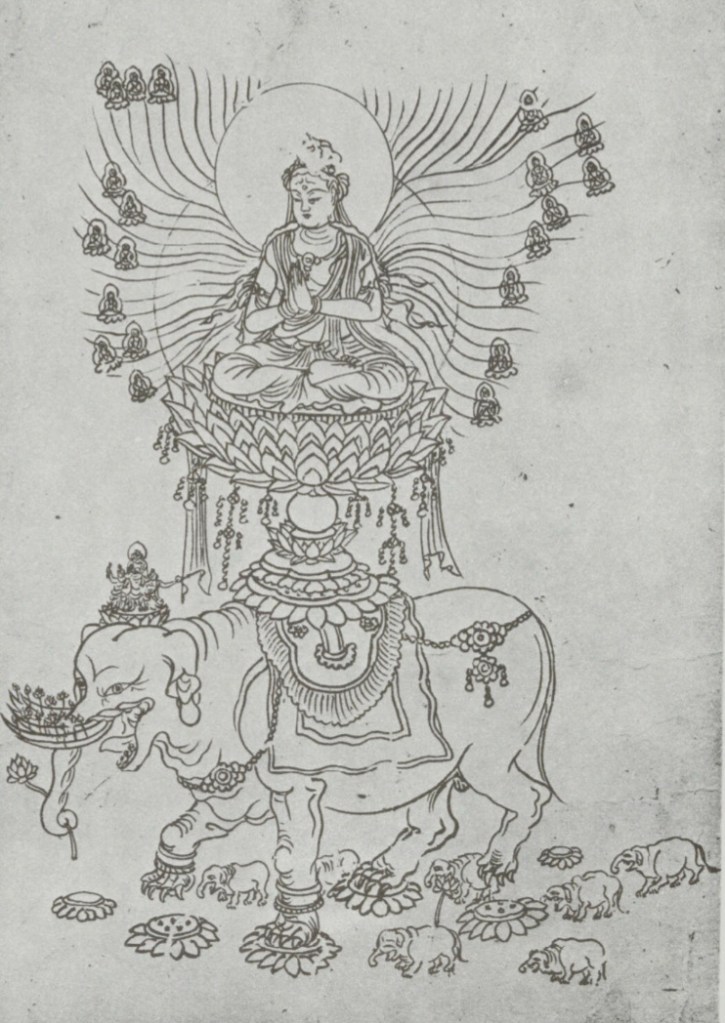
[0389c27] 「普賢菩薩身量無邊、音聲無邊、色像無邊,欲來此國,入自在神通促身令小,閻浮提人三障重故。以智慧力化乘白象,其象六牙,七支跓地,其七支下生七蓮華。象色鮮白,白中上者頗梨、雪山不得為比。身長四百五十由旬、高四百由旬。於六牙端有六浴池,一一浴池中生十四蓮華,與池正等,其華開敷如天樹王。一一華上有一玉女,顏色紅輝有過天女,手中自然化五箜篌,一一箜篌有五百樂器以為眷屬。有五百飛鳥,鳧、鴈、鴛鴦……,皆眾寶色,生花葉間。象鼻有華,其莖譬如赤真珠色,其華金色,含而未敷。
“Samantabhadra Bodhisattva’s body is aprameyas in height, aprameyas in voice, aprameyas in rūpas, and so desiring to come to this land, he enters into the ṛddhibala of self-sovereignty and immediately causes his body to shrink in size for the people of Jambudvīpa who are of heavy hindrances. With the power of his prajñā he manifests his mount of a white elephant. This elephant has six tusks, and seven extremities which touch the ground, and below these seven extremities grow seven lotus flowers. The colour of this elephant is pure white, the white of which is superior to spaṭhika, of which even Mt. Himavat cannot compare. The body’s height is four-hundred and fifty yojanas in length, and four-hundred yojanas in height. Upon the tips of the six tusks are six puṣkariṇī-ponds, and within each and every puṣkariṇī-pond grow fourteen lotus flowers, together the pond is well-formed, and these flowers open out out the distance similar to the Pārijāta Tree of the Trāyastriṃśa Devas. Atop each and every flower are an apsara, their countenances give out padma light the colour of which surpasses those of the devīs, and within their hands are transformationally manifested five-stringed vīṇās, each and every vīṇā has five-hundred musical instruments as their attendants. There are five-hundred flying birds such as the krauñca, the haṃsa, the cakravāka, and so on. All of which are the colour of multitudinous jewels, and which arise between the flowers and lilypads. The elephant’s trunk holds a flower, the stalk of this flower resembles the colour of lohitamuktā, while the flower is the colour of suvarṇa, with a bud which has not yet bloomed.”
[0390a09] 「見是事已,復更懺悔,至心諦觀,思惟大乘,心不休廢。見華即敷,金色金光,其蓮華臺是甄叔迦寶,妙梵摩尼以為華鬘、金剛寶珠以為華鬚。見有化佛坐蓮華臺,眾多菩薩坐蓮華鬚。化佛眉間亦出金光入象鼻中,從象鼻出入象眼中,從象眼出入象耳中,從象耳出照象頂上,化作金臺。
“After having seen these things, one should further practise repentance, and with one’s mind, one should carefully contemplate and ponder the Mahāyāna with a mind unwavering. One should see this flower immediately bloom, with the colour of suvarṇa, with rays of suvarṇa, and holding up a lotus pedestal made of kiṃśuka jewels. Sublime brahmamaṇis serve as the flower’s dāma-wreaths, and with vajraratnamaṇis serving as the flower’s pistil and stamens. Between the eyebrows of the Nirmāṇakāya Buddha issue forth suvarṇa rays which enter within the trunk of the elephant, exit from within the trunk of the elephant and enter within the eyes of the elephant, exit from within the eyes of the elephant and enter within the ears of the elephant, exit from within the ears of the elephant and illuminating the crown of the elephant, and there transformationally producing a suvarṇa pīṭha-pedestal.”
[0390a16] 「其象頭上有三化人:一捉金輪、一持摩尼珠、一執金剛杵。舉杵擬象,象即能行,腳不履地,躡虛而遊,離地七尺。地有印文,於印文中千輻轂輞皆悉具足,一一輞間生一大蓮華,此蓮華上生一化象,亦有七支,隨大象行。舉足下足生七千象以為眷屬,隨從大象。
“Atop this elephant’s head are three transformationally manifested beings: one holds a suvarṇacakra, one holds a cintāmaṇimuktā, and one wields a vajragadā. Upon lifting up his vajragadā he instructs the elephant, the elephant is then able to immediately to walk forward with legs which tread not upon the ground. He steps and walks within the air, seven vistatis above the ground. The ground has an impression of an auspicious seal and within the impression of of this auspicious seal is a thousand-spoked wheel with its hubs and outer rim well-formed. Within each section between the rim arises a single great lotus flower, and above each of the lotus flowers arise a nirmāṇakāya elephant which also has seven extremities, and who also walks together with the larger elephant. With the raising and lowering of his feet, the elephant gives rise to these seven-thousand elephants which serve as his retinue, and who also follow this larger elephant.”
[0390a22] 「象鼻紅蓮華色,上有化佛放眉間光,其光金色,如前入象鼻中,於象鼻中出入象眼中,從象眼出還入象耳,從象耳出至象頸上,漸漸上至象背,化成金鞍,七寶校具。於鞍四面有七寶柱,眾寶校飾以成寶臺。
“The elephant’s trunk has the colour of a padma flower, and above his trunk is a Nirmāṇakāya Buddha Who issues forth a ray between His eyebrows, this ray is the colour of suvarṇa, and just like before, it enters within the elephant’s trunk, and within the elephant’s trunk enters within the elephant’s eyes, and exiting from the elephant’s eyes circles around and enters the elephant’s ears, and exiting from the elephant’s ears reaches above the elephant’s neck, gradually moves its way up the elephant’s back, and transforms into a complete suvarṇa saddle, endowed with a mixing of the seven jewels. Atop the four corners of the saddle are seven-jewelled stambhas, many groups of jewels, and intermingling ornaments, with form to create a jewelled pīṭha.”
[0390a26] 「臺中有一七寶蓮華,其蓮華鬚百寶共成,其蓮華臺是大摩尼,有一菩薩結加趺坐,名曰普賢。身白玉色五十種光,光五十種色以為項光,身諸毛孔流出金光,其金光端無量化佛。諸化菩薩以為眷屬,安庠徐步,雨大寶華至行者前。其象開口,於象牙上諸池玉女鼓樂、絃歌,其聲微妙,讚歎大乘一實之道。
“In the middle of this jewelled pīṭha is a seven-jewelled padmāsana, this padmāsana’s pistils and stamens are composed of a hundred jewels, this padmāsana’s pītha holds a Mahāmaṇi, and a single bodhisattva sits atop the padmāsana in lotus pose. His name is Samantabhadra. His body is the colour of hastigarbha and it issues forth fifty kinds of rays. Rays of fifty kinds of colours serve as a prabhāmaṇḍala around his neck. His body’s various pores pour forth rays of suvarṇa, and at the tips of these rays of suvarṇan are aprameyas of Nirmāṇakāya Buddhas with various Nirmāṇakāya Bodhisattvas serving as attendants. They then quietly and slowly approach the practitioner, raining down great jewels of flowers. This elephant then opens his mouth, and atop the elephant’s tusks with their various puṣkariṇī-ponds, the apsaras hold their musical instruments playing them while singing with voices gentle and sublime — praising and venerating the Mahayana’s Path of the One Truth.”
[0390b04] 「行者見已,歡喜敬禮。復更誦讀甚深經典、遍禮十方無量諸佛、禮多寶塔及釋迦牟尼、并禮普賢……諸大菩薩,發是誓言:『若我宿福應見普賢,願尊遍吉示我色身。』作是願已,晝夜六時禮十方佛、行懺悔法、誦大乘經、讀大乘經、思大乘義、念大乘事、恭敬供養持大乘者、視一切人猶如佛想、於諸眾生如父母想。
“After the practitioner has seen these things, one should joyfully pay obeisance. Furthermore, one should recite aloud the deeply profound scriptures, pay obeisance unto all of the aprameyas of Buddhas within the ten directions, pay obeisance unto the Stūpa of Prabhūtaratna and to Śākyamuni, together with Samantabhadra, and so on. And unto all of the Mahābodhisattvas, one should issue forth this vow:
“If the merits of my previous lives allows me to see Samantabhadra, then I vow to venerate all-pervasive wholesomeness and manifest for others my own rūpakāya.”
Having produced this vow, during the six times of the day-and-night, one should pay obeisance unto the Buddhas in the ten directions, practising this method of repentance, reciting the Mahāyāna Sūtras, reading the Mahāyāna Sūtras, pondering the principles of the Mahāyāna, arousing smṛti toward the topics of the Mahāyāna, revering and making offerings to upholders of the Mahāyāna, regarding all beings as if one is visualising the Buddhas, regarding all people by visualising them as the Buddhas, regarding all sentient beings by visualising them as one’s father and mother.”
[0390b12] 「作是念已,普賢菩薩即於眉間放大人相白毫光明。此光現時,普賢菩薩身相端嚴——如紫金山端正微妙——三十二相皆悉備有。身諸毛孔放大光明,照其大象令作金色、一切化象亦作金色、諸化菩薩亦作金色。其金色光,照于東方無量世界皆同金色,南、西、北方、四維、上、下亦復如是。
“After one has aroused smṛti, Samantabhadra Bodhisattva will immediately issue forth between his eyebrows — the major mark of a Mahāpuruṣa — rays of light. When these rays manifest, the marks of Samantabhadra Bodhidattva’s body — resembling a mountain of handsome and sublime jāmbūnadasuvarṇa — the thirty-two major marks will all be manifest. His body’s various pores issue forth great rays of light, which illuminate the great elephant and cause this elephant to become colour of suvarṇa, cause all of the nirmāṇakāya elephants too to become the colour of suvarṇa, and cause all of the bodhisattvas too to become the colour of suvarṇa. These suvarṇa coloured rays will illuminate aprameyas of lokadhātus within the eastern direction, which too similarly become the colour of suvarṇa, and furthermore, within the southern, western, and northern directions, as well the four intermediate directions, and the zenith and the nadir, they too will also become the same.”
[0390b19] 「爾時,十方面一一方有一菩薩乘六牙白象王,亦如普賢等無有異,如是十方無量無邊滿中化象。普賢菩薩神通力故,令持經者皆悉得見。
“At that time, facing the ten directions, facing each and every direction, there will be a bodhisattva mounted atop a six-tusked white hastirāja-elephant, who also resemble Samantabhadra, equal and without difference, and likewise within the ten directions, there will be aprameyas of aparimāṇas of nirmāṇakāya elephants. Through the ṛddhibala of Samantabhadra Bodhisattva, he will cause all those who uphold the sūtras to obtain vision of him.”
[0390b22] 「是時,行者見諸菩薩身心歡喜,為其作禮,白言:『大慈大悲者!愍念我故,為我說法。』說是語時,諸菩薩等異口同音各說清淨大乘經法,作諸偈頌讚歎行者,是名始觀普賢菩薩最初境界。
“This being so, the practitioner will see all of the bodies of these bodhisattvas, and with one’s mind delighted, one should then serve them and pay obeisance unto them, saying:
“Ones of Mahākaruṇā and Mahāmaitrī! Kindly uphold smṛti unto me and explain to me the Dharma.”
Having spoken these words, all of those bodhisattvas will, with different mouths but the same voice, further expound upon the Dharma of the Pure Mahāyāna Sūtras, making various gāthās in praise of the practitioner. This is called the first contemplation of Samantabhadra Bodhisattva’s Utmost Ālambanas.”
[0390b27] 「爾時,行者見是事已,心念大乘,晝夜不捨。於睡眠中夢見普賢為其說法,如覺無異,安慰其心而作是言:『汝所誦持,忘失是句、忘失是偈。』爾時,行者聞普賢菩薩所說,深解義趣,憶持不忘;日日如是,其心漸利。
“At that time, after the practitioner has beheld these scenes, one should arouse a mind of smṛti toward the Mahāyāna, without abandoning it throughout the day and night. Within one’s drowsiness and sleep, one will dream of seeing Samantabhadra giving these expositions on Dharma, as if awake and no different, and will encourage one’s mind by saying:
“You who recites and upholds this Dharma, will never forget the ślokas nor forget the gāthās.”
At that time, the practitioner will be taught by Samantabhadra Bodhisattva, obtain the dharmadhāraṇī, the arthadhāranī, and the avismaraṇadhāranī. Day by day, in this way, one’s mind will gradually profit.”
[0390c02] 「普賢菩薩教其憶念十方諸佛,隨普賢教正心正意,漸以心眼見東方佛,身黃金色,端嚴微妙。見一佛已,復見一佛,如是漸漸遍見東方一切諸佛;心相利故,遍見十方一切諸佛。
“Samantabhadra Bodhisattva will teach the method of the Pratyutapannasamādhi, and having accorded with Samantabhadra’s teachings with an upright mind and upright intention, one will gradually see with the mind’s eye, the Buddha of the eastern direction, Who has a body the colour of suvarṇa, beautiful and sublime. After seeing this one Buddha, one will see another Buddha, and gradually, one by one, everywhere, one will see all of the Buddhas in the eastern direction; the nature of one’s mind will profit and one shall everywhere see all of the Buddhas in the ten directions.”
[0390c06] 「見諸佛已,心生歡喜而作是言:『因大乘故得見大士,因大士力故得見諸佛,雖見諸佛猶未了了,閉目則見,開目則失。』作是語已,五體投地遍禮十方佛。禮諸佛已,胡跪合掌而作是言:『諸佛世尊十力無畏、十八不共、大慈大悲三念處、常在世間色中上色,我有何罪而不得見?』說是語已,復更懺悔。
“Having seen these Buddhas, the mind will give rise to joy and one ought to say these following words:
“By the causes of the Mahāyāna I have attained vision of the Mahāsattva, and by the causes of the Mahāsattva’s power I have attained vision of all these Buddhas. Yet my vision of all these Buddhas is still not clear and distinct, for when I close my eyes I have vision, but when I open them I do not.”
Having said these words, one should prostrate oneself with the five extremities upon the ground, paying obeisance unto all the Buddhas within the ten directions. After having payed obeisance unto the Buddhas, one should kneel with hands together in añjali, and with one’s right knee upon the ground, say the following:
“All of the Buddha Bhagavāns in the ten directions — Who have the ten balas, the vaiśāradyas, the eighteen aveṇikas, mahāmaitrī and mahākaruṇā, the three smṛtyupasthānas, Who have superior rūpas which ever-abide within the rūpa of the lokadhātu — what kinds of transgressions have I committed such that I am unable to see Them?”
Having said this, one should practise further repentance.
[0390c13] 「懺悔清淨已,普賢菩薩復更現前,行、住、坐、臥不離其側,乃至夢中常為說法;此人覺已,得法喜樂。如是晝夜經三七日,然後方得旋陀羅尼;得陀羅尼故,諸佛菩薩所說妙法憶持不失,亦常夢見過去七佛,唯釋迦牟尼佛為其說法,是諸世尊各各稱讚大乘經典。
“Having purified oneself through repentance, Samantabhadra Bodhisattva will again manifest before oneself. Whether one is walking, standing, sitting, or lying down, one will never be separated from his side, even up to and including within one’s dreams. He will ever abide and expound upon the Dharma, and after one has gained realisation, one will obtain Dharmaprītisukha. In this way, day and night, after twenty-one days, one will furthermore obtain the Āvartādhāraṇī, and due to having obtained this dhāraṇī, one will have unwavering smṛti connected to the Sublime Dharmas of the various Buddhas and Bodhisattvas. Furthermore, one will always obtain vision of the Seven Past Buddhas within one’s dreams, wherein Śākyamuni Buddha alone will expound on the Dharma while the other Bhagavāns each render praise unto the Scriptures of the Mahāyāna.”
[0390c20] 「爾時,行者復更懺悔,遍禮十方佛。禮十方佛已,普賢菩薩住其人前,教說宿世一切業緣、發露黑惡一切罪事。向諸世尊,口自發露;既發露已,尋時即得諸佛現前三昧。
“Therein, the practitioner should further practise repentance, paying obeisance unto the Buddhas within the Ten Directions. Having paid obeisance unto the Buddhas within the Ten Directions, Samantabhadra Bodhisattva will stand before oneself, lecture upon all the causes and conditions of one’s prior lifetimes, reveal all of one’s transgressions caused by one’s past black and evil karmas. One should then face oneself unto the various Bhagavāns, and with one’s mouth confess of them, and after having confessed them, one will immediately and directly obtain the Pratyutpannasamādhi.”
[0390c23] 「得是三昧已,見東方阿閦佛及妙喜國,了了分明。如是,十方各見諸佛上妙國土,了了分明。
“Having obtained this Samādhi, one should behold Akṣobhya Buddha of the Eastern Direction and His Land of Abhirati, clearly and distinctly. In the same way, one should behold each of the utterly sublime kṣetras of the various Buddhas within each of the Ten Directions, clearly and distinctly.”
[0390c25] 「既見十方佛已,夢象頭上有一金剛人,以金剛杵遍擬六根;擬六根已,普賢菩薩為於行者說六根清淨懺悔之法。如是懺悔一日至七日,以諸佛現前三昧力故、普賢菩薩說法莊嚴故,耳漸漸聞障外聲、眼漸漸見障外事、鼻漸漸聞障外香。廣說如妙法華經得是六根清淨已,身心歡喜無諸惡相,心純是法,與法相應。
“Having beheld the Buddhas within the ten directions, then within one’s dream, atop the elephant’s head will be that vajra being holding his vajragadā. He will point out in detail all of one’s Six Sense Indriyas, and after having pointed out one’s Six Sense Indriyas, Samantabhadra Bodhisattva will expound upon the Method on the Repentance which Purifies the Six Sense Indriyas.”
[0391a04] 「復更得百千萬億旋陀羅尼,復更廣見百千萬億無量諸佛。是諸世尊各伸右手摩行者頭,而作是言:『善哉善哉!行大乘者!發大莊嚴心者!念大乘者!我等昔日發菩提心時皆亦如汝,慇懃不失。我等先世行大乘故,今成清淨正遍知身;汝今亦當勤修不懈。此大乘典,諸佛寶藏、十方三世諸佛眼目、出生三世諸如來種。持此經者,即持佛身、即行佛事,當知是人即是諸佛所使、諸佛世尊衣之所覆、諸佛如來真實法子。汝行大乘,不斷法種。汝今諦觀東方諸佛。』
“One will further obtain the Koṭiśatasahasravartādhāraṇī, and will further be able to extensively behold hundreds of thousands of lakṣas of śatasahasras of aparimāṇas of various Buddhas. Each of these Buddhas will reach out Their hands and stroke the head of the practitioner, and will then issue forth these words:
“Sādhu! Sādhu! O, Practitioner of the Mahāyāna! O, One Who Issues Forth a Mind of Mahāvyūha! O, One of Smṛti Toward the Mahāyāna! When We, in former eras, issued forth Bodhicitta like yourself, We strove unwaveringly. We, in prior lifetimes, practised the Mahāyāna, and have now formed the Pure and Upright Sarvajñakāya. You should now also arouse vīrya and not become indolent. This Mahāyāna Canon is the Ratnagarbha of all the Buddhas, it is the Eye Indriya of all the Buddhas in the Ten Directions, and it gives birth to the Family of the Tathāgatas of the Three Times. One who obtains this sūtra will immediately obtain the Buddhakāya, and therein practise the Buddhakāryas. It should be known that this person has been issued forth by the various Buddhas, clothed in the garments of the various Buddha Bhagavāns, and is the Satyadharmaputra of the various Tathāgatas. You will now practise the Mahāyāna, unsevered from the Dharmagotra. You will now perfectly behold the various Buddhas within the Eastern Direction.”
[0391a14] 「說是語時,行者即見東方一切無量世界地平如掌,無諸堆阜、丘陵、荊棘,琉璃為地,黃金間側;十方世界亦復如是。見是地已,即見寶樹。寶樹高妙五千由旬,其樹常出黃金、白銀、七寶莊嚴,樹下自然有寶師子座。其師子座高二十由旬,座上亦出百寶光明。如是諸樹及餘寶座,一一寶座皆有自然五百白象,象上皆有普賢菩薩。
“When these words are expounded, the practitioner will immediately behold all the aprameyas of lokadhātus in the eastern direction with earths as level as one’s palm, without any of the various hills, mounds, or thorny thickets. Their earths will be made of vaiḍūrya, laid out with sections of suvarṇa. Furthermore, the rest of the lokadhatus within the ten directions will likewise appear the same. Having beheld their earth, one will immediately be able to behold the jewelled trees. The jewelled trees are fifty yojanas tall and are sublime. These trees constantly issue forth decorations of suvarna, rūpya, and the rest of the seven jewels. Below the trees are transformationally manifested Siṃhāsanas. These Siṃhāsanas have a height of twenty yojanas, and above these thrones also issue forth the rays of light from a hundred jewels. In this way, all of the trees have jewelled thrones. Beside each and every one of the jewelled thrones are also spontaneously manifested white elephants. And above each elephant is a Samantabhadra Bodhisattva.”
[0391a22] 「爾時,行者禮諸普賢而作是言:『我有何罪,但見寶地、寶座及與寶樹,不見諸佛?』作是語已,一一座上有一世尊,端嚴微妙而坐寶座。
“Therein, the practitioner should pay obeisance unto the various Samantabhadras and isssue forth these words:
“What transgressions have I committed such that I behold only the jewelled earth, the jewelled throne, and the jewelled trees, but behold not the various Buddhas?”
Having said these words, above each and every throne, there will appear a Bhagavān, beautiful to behold, sublime in countenance, sitting upon these jewelled thrones.”
[0391a25] 「見諸佛已,心大歡喜,復更誦習大乘經典。大乘力故,空中有聲而讚歎言:『善哉善哉!善男子!汝行大乘功德因緣,能見諸佛。今雖得見諸佛世尊,而不能見釋迦牟尼佛、分身諸佛及多寶佛塔。』聞空中聲已,復勤誦習大乘經典。以誦大乘方等經故,即於夢中見釋迦牟尼佛與諸大眾在耆闍崛山說《法華經》,演一實義。
“Having seen the various Buddhas, one’s mind will be comegreatly delighted, and one should furthermore recite aloud the scriptures of the Mahāyāna. Then, through the power of the Mahāyāna, issuing forth from within empty space, one will a hear a voice offering words of praise:
“Sādhu! Sādhu! O Kulaputra! You have now cultivated the causes and conditions of the merit of the Mahāyāna, and have thus gained vision of the many Buddhas. Now, while you may have obtained vision of the may Buddha Bhagavāns, you are still yet unable to behold the Buddha Śākyamuni, His various Partial-Embodiments, and the Stūpa of the Buddha Prabhūtaratna.”
Having heard this voice issuing forth from within empty space, one should furthermore strive to recite the Mahāyāna Scriptures. By means of these Mahāyāna Vaipulya Sūtras one will then behold, within one’s dream, Śākyamuni Buddha together with His Mahāsaṃgha atop Mt. Gṛdhrakūṭa, expounding the Dharma Flower Sūtra, and giving a sermon on the Principle of the One Truth.”
[0391b03] 「教已懺悔,渴仰欲見,合掌胡跪向耆闍崛山而作是言:『如來世雄常在世間,愍念我故,為我現身。』作是語已,見耆闍崛山七寶莊嚴,無數比丘、聲聞大眾,寶樹行列,寶地平正,復鋪妙寶師子之座。釋迦牟尼佛放眉間光,其光遍照十方世界,復過十方無量世界。
“Having been taught, one should do further repentance. For those longing for and desiring this vision, then one should hold one’s hands in añjali, kneel with one’s right knee upon the ground, face Mt. Gṛdhrakūṭa, and say:
“O Tathāgata, O Lokanāyaka, He Who is ever-abiding on the world, due to Your sympathetic mindfulness towards me, I have been enabled to behold Your Nirmāṇakāya.”
Having said this, one should be able to then behold Mt. Gṛdhrakūṭa adorned with the seven jewels, with its aprameyas of bhikṣus, with its mahāśrāvakasaṃgha, with its rows of jewelled trees, with its excellently level earth, and laid out with sublimely jewelled Siṃhāsanas. Śākyamuni Buddha will then issue forth a ray from between His eyebrows, the ray will then encircle and illuminate the lokadhātus throughout the ten directions, and furthermore, pass through the aprameyas of lokadhātus throughout the ten directions.”
[0391b09] 「此光至處,十方分身釋迦牟尼佛一時雲集,廣說如《妙法華經》。一一分身佛,身紫金色、身量無邊、坐師子座,百億無量諸大菩薩以為眷屬,一一菩薩行同普賢;如此十方無量諸佛、菩薩眷屬,亦復如是。
“This ray will pass through all of those places, and at that time, the Partial-Embodiments within the Ten Directions of Śākyamuni Buddha will gather together like clouds, as has explained in detail within the Sublime Dharma Flower Sūtra. Each and every Partial-Embodiment Buddha, with Their bodies of raktasuvarṇa in colour, with Their bodies aprameyas and aparimāṇas in height, will sit atop a Siṃhāsana. There will be a koṭi of aprameyas of various mahābodhisattvas serving as Their retinues, and with each and every bodhisattva practising in the same way as Samantabhadra. In the same way, the aprameyas of various Buddhas within the ten directions, with Their retinues of bodhisattvas, will do likewise.”
[0391b13] 「大眾集已,見釋迦牟尼佛舉身毛孔放金色光,一一光中有百億化佛。諸分身佛放眉間白毫大人相光,其光流入釋迦牟尼佛頂。見此相時,分身諸佛一切毛孔出金色光,一一光中復有恒河沙微塵數化佛。
“After that Mahāsaṃgha has gathered, one ought to see Śākyamuni Buddha together with His body and pores issuing forth suvarṇa-coloured rays, and within each and every ray, a hundred śatasahasra Nirmāṇakāya Buddhas. Those various Partial-Embodiment Buddhas should then issue forth rays from between Their eyebrows — the mark of a Mahāpuruṣa — and these rays will flow into the head of Śākyamuni Buddha. When one then sees this sign, the various Partial-Embodiment Buddhas will all issue forth suvarṇa-coloured rays, and within each and every ray there will be a further paramāṇus of sands of the ganges number of Nirmāṇakāya Buddhas.”
[0391b18] 「爾時,普賢菩薩復放眉間大人相光入行者心。既入心已,行者自憶過去無數百千佛所受持讀誦大乘經典,自見故身了了分明,如宿命通等無有異;豁然大悟,得旋陀羅尼、百千萬億諸陀羅尼門。
“Therein, Samantabhadra Bodhisattva will further issue forth a ray from between his eyebrows — the mark of a Mahāpuruṣa — which will enter into the mind of the practitioner. After having entered into one’s mind, the practitioner will recollect the Mahāyāna Scriptures received, upheld, and recited in presence of aparimāṇas of hundreds of thousands of Buddhas in the past. And due to seeing one’s own bodies clearly and distinctly, it will be just like and no differently to the Abhijñā of Recollecting One’s Past Lives. One will suddenly attain to Mahābodhi, obtain the Vartādhāraṇī, as well as hundreds of thousands of lakṣas of śatasahasras of Dhāraṇimukhas.”
[0391b22] 「從三昧起,面見一切分身諸佛眾寶樹下坐師子床,復見琉璃地如蓮華聚,從下方空中踊出。一一華間有微塵數菩薩結加趺坐,亦見普賢分身菩薩在彼眾中讚歎大乘。
“Arising from this samādhi, one should face towards the Saṃgha of the many Partial-Embodiment Buddhas sitting upon Their Siṃhāsanas situated below the jewelled trees. Furthermore, on should see the vaiḍūrya earth and what seems to be a cluster of padmas springing forth from within the nadir direction of empty space. Within each and every flower are paramāṇus in numbers of bodhisattvas sitting in cross-legged position, and one should further see the Samantabhadra Partial-Embodiment Bodhisattvas within that Saṃgha praising the Mahāyāna.”
[0391b26] 「時諸菩薩異口同音教於行者清淨六根,或有說言:『汝當念佛。』或有說言:『汝當念法。』或有說言:『汝當念僧。』或有說言:『汝當念戒。』或有說言:『汝當念施。』或有說言:『汝當念天。』『如此六法是菩提心、生菩薩法。汝今應當於諸佛前發露先罪,至誠懺悔於無量世眼根因緣貪著諸色。以著色故,貪愛諸塵;以愛塵故,受女人身,世世生處惑著諸色。色壞汝眼,為恩愛奴;色使使汝經歷三界,為此弊使,盲無所見。今誦大乘方等經典,此經中說:「十方諸佛色身不滅。」汝今得見,審實爾不?眼根不善,傷害汝多,隨順我語歸向諸佛。釋迦牟尼說汝眼根所有罪咎,諸佛菩薩慧明法水願以洗除,令我清淨。』
“Then the various bodhisattvas, with different mouths but the same voice, will instruct the practitioner on the Purification of the Six Sense Indriyas.
Some will say these words: “You ought to practise Buddhānusmṛti”;
Some will say these words: “You ought to practise Dharmānusmṛti”;
Some will say these words: “You ought to practise Saṃghānusmṛti;
Some will say these words: “You ought to practise Śīlānusmṛti”;
Some will say these words: “You ought to practise Dānānusmṛti”;
Some will say these words: “You ought to practise Devānusmṛti.”
“For the Six Anusmṛtis is Bodhicitta itself, and from them comes the birth of the Bodhisattvadharma. You must now openly reveal your prior transgressions before the various Buddhas, and sincerely repent of the aprameyas of lifetimes of causes and conditions of your Eye Indriya’s craving and attachment to various rūpas. For due to attachment to rūpas you have thirsted over various ālambanas. Likewise, due to desire toward ālambanas, you have assumed a female body, and in lifetime after lifetime, given rise to the locus of delusion and attachment toward various rūpas. Thus, rūpa has brought ruin upon your eyes, and has caused you to become a slave to affection. Due to having been afflicted by the rūpakleśas, you have revolved throughout the Three Spheres, and due to crude kleśas, you have become blinded and have not been able to see. You ought to now recite the Mahāyāna Vaipulya Scripture, for as this sūtra says: “the Rūpakāyas of the various Buddhas in the Ten Directions are unceasing.” Now that you have attained vision of Them, is this true or not? The Eye Indriya is unwholesome, and has done much harm to you indeed. And so heed my words by taking refuge in all the Buddhas. May Śākyamuni Buddha expound unto you the faults of your Eye Indriya so that the water of the luminous wisdom of the Dharma of the Buddhas and Bodhisattvas may wash away its faults and enable the purification of the self.”
[0391c11] 「作是語已,遍禮十方佛,向釋迦牟尼佛、大乘經典,復說是言:『我今所懺眼根重罪障蔽穢濁,盲無所見。願佛大慈哀愍覆護、普賢菩薩乘大法船普度一切、十方無量諸菩薩伴唯願慈哀,聽我悔過眼根不善惡業障法。』如是三說,五體投地、正念大乘、心不忘捨,是名懺悔眼根罪法。
“After this words are spoken, one ought to pay obeisance unto the Buddhas within the ten directions, face towards Śākyamuni Buddha and the Mahāyāna Scriptures, and furthermore say:
“The heavy transgressions of my hindered, turbid, and defiled Eye Indriya, of which I now confess, has blinded me such that I have been unable to see. May the Buddha, in His Mahāmaitrī and Karuṇā, protect and shelter me, may Samantabhadra Bodhisattva, in the Great Vessel of the Dharma, universally ferry over all beings, may the aprameyas of bodhisattva attendants, with their maitrī and karuṇā, hear of my repentance of the Eye Indriya’s dharmas of unwholesome and evil karmas.”
Say this three times in this way, and then prostrate with five extremities on the ground with an upright mind of smṛti towards the Mahāyāna. Allow not for your mind to forget nor abandon it. This is called the Method of Repentance of the Transgressions of the Eye Indriya.”
 Saddharmatā