佛說法華三昧經一卷
The Buddha Expounds the Dharma Flower Samādhi Sutra, Scroll 1
宋涼州沙門智嚴譯
Translated by the śramaṇa Zhiyan of Liangzhou during the Song Dynasty
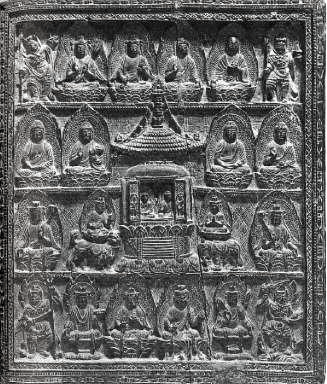
Accessed at: 佛說法華三昧經
Page 1 | Page 2
[0285c28] 佛在羅閱祇耆闍崛山中,與諸尊弟子比丘千二百五十,菩薩七萬三千人,諸釋梵不可復計,十方飛來無央數,皆神通妙達,復有他方恒邊沙諸天人及諸菩薩,如是等百億千恒沙皆來會,在佛前坐。
At that time, the Buddha was residing within Rājagṛha, Vulture’s Peak, together with His honoured disciples:
An assembly of various monastics numbering one thousand two hundred and fifty in number, and bodhisattvas, totalling seventy-three thousand in number.
There were also various hosts of Śakras and Brahmās, incalculable in number who from the ten directions, had all flown here. They had all penetrated deep within the sublimities of psychic powers.
There were also from other lands numbering the great sands of the Ganges various heavenly and human beings as well as various bodhisattvas, who were themselves equal to ten billion by one thousand times the great sands of the Ganges.
All of them arrived at this assembly, and then came and sat before the Buddha.
[0286a03] 時舍利弗、須菩提等諸尊菩薩皆有疑,心念言:「何因緣諸上人皆來在是間會?有何異要之瑞應?」爾時,諸弟子起疑心念,為佛作禮長跪,欲問佛。
Then, Sāriputra, Subhūti, and all of the various heavenly beings and bodhisattvas had doubts arise in their minds and in their minds they wondered:
“What are the causes and conditions for all of these various supreme beings to have arrived here at this assembly? What are the reasons for all of these auspicious signs?”
At that time, the various disciples had thus given rise to doubt in their minds, and thus went and paid obeisance unto the Buddha. Kneeling before Him, they desired to ask the Buddha their questions.
[0286a06] 佛時已放無數光從口出,若千億億稍稍引大遍虛空明,遠照恒邊沙剎土,地復震動,於是盡明,即不復見佛身相。大眾愕然,共議:「佛三昧為何所之趣?」各自思之,即便還坐三昧求佛至處。座前有菩薩名慧相,便報言:「善哉,善哉!當爾賢者思惟,了不知所至處。」
The Buddha then issued forth innumerable rays of light from His mouth, a hundred billion individual rays filled the entirety of empty space itself, distantly illuminating worlds numbering the great sands of the Ganges, and therein caused the earth of those worlds to shake.
When the light had thus filled the entirety of space, the assembly could no longer see the body of the Buddha.
Thus the great assembly was astonished at this sight and they all spoke in unison:
“To what destination has the Buddha, Who was abiding in samadhi, gone?”
Each of them wished to contemplate on this matter and so entered into seated samādhi; they sought after the location to which the Buddha had gone. Sitting before them was the Bodhisattva named Prajñālakṣaṇa (Mark of Wisdom), who responded:
“Sādhu! Sādhu! Truly, even though you āryas attempt to contemplate in such a manner, still you are unable to know whence the Buddha disappeared.”
[0286a12] 須臾,羅閱王後宮太子皇女及婇女夫人三萬二千人,皆從共來詣山中,到不見佛。復有不想菩薩問王:「將從何多?」王名辯通,答言:「見佛光明故來耳。」
After a short while, the king of Rājagṛha, the crown prince, the princess, the king’s concubines and wives, all thirty-two thousand in number came together to the mountain to pay homage, but they too were also unable to see where the Buddha had gone.
Then, the Bodhisattva Asaṃkalpita (Non-Discriminating) asked the king:
“Why have you come here commanding such a great many people?”
The king named Vibhāgābhijña (Unhindered Eloquence), replied saying:
“We had come here for we had heard of the Buddha’s brilliant radiance.”
[0286a16] 王女名利行,便問菩薩:「佛今所在?為到何方?」
The princess named Arthācaryā (Beneficent Practice), then asked the bodhisattva:
“Where is the Buddha right now? In which direction has He gone?”
[0286a17] 答曰:「向已求佛,了不知。」
The bodhisattva replied:
“We had sought after the Buddha, but know not where He is.”
[0286a17] 處女答曰:「卿是佛第一神通者,應當知處。」
The maiden concubines then replied:
“You are the one who is the Buddha’s foremost in psychic power, you must surely know where He is.”
[0286a18] 菩薩答曰:「且坐。」須臾頃,地即震動。從地中出,坐自然大寶蓮華上,眾坐上人愕然。
The bodhisattva replied:
“Please have a seat here in the meantime.”
Then after a short while, the earth shook, and from within the earth, the Buddha spontaneously arose sitting atop a Great Treasure Lotus Throne and sat above the assembly, who were themselves amazed by this sight.
[0286a20] 王女利行起,為佛作禮訖,住佛前說偈問佛:
「向見大光明, 疑佛有異要,
故來將大眾, 欲問心狐疑。
反更不見佛, 意甚有怪驚,
願得具為說, 當令大眾解。
各發一三昧, 推求佛身相,
了言不知處, 各共坐作議:
『更起何三昧, 畢欲求佛意。』
女來問眾等: 『佛今為所在?』
純行有至心, 必欲有所問,
願見世尊授, 令意解狐疑。
具為現眾等, 分別解說之,
向所三昧處, 所名在何所?」
Princess Arthacaryā then arose, paid obeisance unto the Buddha, and before the Buddha — Who was sitting atop the throne — asked the Buddha questions in verse:
“After beholding the Buddha’s great and resplendent radiance,
We wondered if the Buddha had a special intent for this;
Thus we have come to this great assembly,
Desiring the ask about this so that we may clear our minds of doubt.However, we could not see the Buddha,
And our minds were struck with intense bewilderment;
May we be taught in full,
So that this great assembly may understand this matter.
Each one here had entered a samādhi,
Hoping to see the body of the Buddha;
Yet could not ascertain His whereabouts,
And together they sat and discussed:“What other samādhi should we generate,
To comprehend the Buddha’s intent?”Then the women came and asked the assembly:
“Where is the Buddha right now?”They have practised pure conduct and possessed sincere hearts,
They desired the ask about this matter;
They wished to see the Bhagavān and be instructed,
So that their minds of doubt may be dispelled.May He fully manifest before the assembly,
And clearly instruct and expound to us on this matter;
From which place did He abide in this samādhi,
What is the name of this place and this samādhi?”
[0286b05] 佛語女利行:「所問甚深,當為汝分別說。向所三昧,名法華。譬如大國中有一樹,有一華覆三千大千剎土,其香熏恒邊沙佛國。若有人得聞名字、若知解,自然疾得是三昧;若諸病痛者得聞是三昧,應時自解,人根眾病消盡。」
The Buddha then spoke to the maiden Arthacaryā:
“The question you have now asked is deeply profound. I shall now explain it to you in detail. The samādhi in which I had entered is named the Dharma Flower Samādhi.
Akin to a great nation where there is a great tree, and on that tree there grows a single flower whose canopy extends across this three-thousand-great-thousandfold-world and the fragrance of which pervades and perfumes buddhalands numbering the great sands of the Ganges.
If such a person who comes to hear of its name, and if such a person comes to understand and ascertain it, then that person will rightly obtain this samādhi; if various people stricken with illnesses hear of this samadhi, and at that time come to comprehend it, then the roots of such illnesses within that assembly of people will come to be diminished and be exhausted.
[0286b10] 女利行問佛:「何謂華之威德乃有是慧?」
The maiden Arthacaryā then asked the Buddha:
“Why is it that the majesty and merit of this flower possess such wisdom?”
[0286b10] 佛語女利行:「華者,一樹之色,人見莫不愛樂。欲得之者,法華三昧是。生死中之色,大光受有形。人不知、不聞、不信是三昧,不奉行之,未應菩薩不見慧。失人之本,反隨沫流,終已不見明。」
The Buddha replied to the maiden Arthacaryā:
“This flower is the very body of that single tree, and for people who come to see it, there are none who do not obtain delight from it.
For those who wish to obtain it, then they ought know that this is what is called the Dharma Flower Samādhi. Within this body of birth-and-death, this great radiance is able to take its form.
People who do not know of it, do not hear of it, and do not have faith in this samādhi, or who do not accept it with open hands, are not yet bodhisattvas, and have not perceived any wisdom.
Losing the source of their being, they follow along the drifting currents of foam, and in the end, never perceive its radiance.”
[0286b15] 女利行復問佛:「今欲得是三昧,行何法?有幾事行得人中?願佛弘慈恩潤,廣開行議,令一切聞解皆入三昧中。」
The maiden Arthacaryā further asked the Buddha:
“For one who wishes to obtain this samādhi, what methods should one practise?
What kinds of practices does a person enter to obtain it?
I ask, that through the Buddha’s great kindness and compassion, that He would extensively open up and explain these practices to us, so that all who hear and understand it will come to enter into this samādhi.”
[0286b17] 佛言:「善哉,善哉!多所度脫,永度無極。有二事。何謂為二?一者、知法身如幻如化,二者、知婬怒癡無根無形。」
The Buddha said:
“Sādhu! Sādhu! This will liberate many, and forever save innumerable beings.
There are two things. What are these two?
The first is knowledge that the dharmakāya is like an illusion and like a conjuration.
The second is knowledge that greed, hatred, and delusion, are without a foundation and are without form.”
[0286b19] 佛爾時說偈言:
「法身有一切, 化幻現沈浮;
婬怒癡無形, 如水現泡沫。
觀察人身物, 如滅無形住,
離散合自成, 分別計皆空。」
The Buddha, at that time, then spoke in verse:
“The Dharmakāya contains all things,
A conjuration and an illusion, it manifests its vanishing and arising;
Greed, hatred, and delusion are without form,
Like bubbles, they appear upon the surface of water.Observing the bodies of beings and the phenomena of the world,
They perish yet abide without form;
Their scattering and uniting arise spontaneously,
Any discriminations and enumerations are themselves empty.”
[0286b25] 佛語女利行:「復有四事,別如行三昧者。何謂為四?一者、行戒無色想,二者、行檀無受者,三者、不厭無亂者,四者、行智無愚者,是為四。」
The Buddha replied to the maiden Arthacaryā:
“Furthermore, there are also four things that distinguish those who practise this samādhi.
What are these four?
The first is the practice of discipline which is without conceptions of form.
The second is the practice of generosity which is without a concept of a recipient.
The third is the practice of vigour which is without a concept of distraction.
And the fourth is the practice of wisdom which is without any notion of ignorance.
These are the four.”
[0286b27] 佛爾時說偈言:
「不犯戒無毀、 行檀不入智、
不厭無癡亂、 不愚無智慧,
不說無行者, 有行不言向。
三昧可得入, 無處無中邊。」
The Buddha, then at that time spoke in verse:
“Without precepts to transgress, there can be no defilement,
While practising generosity, one does not enter into discriminative understanding;
In unwearying vigour, one is without distraction,
Without ignorance, one is without the lack of wisdom,One who does not speak and does not practise,
Yet practises without directing it toward anything,
May enter and obtain this samādhi,
Which abides nowhere in the middle or the extremes.”
[0286c04] 佛語女利行:「復有三十六事,是為三昧所見事。何謂三十六事?不見生、不見死、不減、不增、不出、不入、不在外、不在內、無住、無止、無水色、無火色、無風色、無地色、無痛、無痒、無思、無想、無生、無死、無識、無貪、無婬、無瞋、無恚、無愚、無癡、無慳、無施、無惡、無善、無心、無意、無識行、不起上若干事、不滅上若干事,如一無形像,是為三十六事法華所見事。」
The Buddha then said to the maiden Arthakiryā:
“Again, there are thirty-six things that are perceived within this samādhi.
What are these thirty-six?
There is no perception of: being born nor dying, no decreasing nor increasing, no going nor coming nor entering, no outside nor inside, no abiding nor ceasing, no elemental basis of water nor fire nor wind nor earth, no pain, no itching, no thoughts, no ideation, no birth, no death, no consciousness, no craving, no greed, no hatred, no hostility, no ignorance, no delusion, no miserliness, no giving, no evil, no good, no mind, no intention, no volitional consciousness, nor the arising of various things above, nor the perishing of the various things above.
All of these are perceived as one, and as without any appearances nor form.
These are the thirty-six things perceived within the Dharma Flower.”
[0286c11] 佛爾時說偈言:
「不想念無念, 不行色想要,
無行法華淨, 空寂無吾我。
不處有入中, 沒滅無形像;
不觀善以惡, 俱皆空自然。」
The Buddha, then spoke in verse:
“Neither thinking nor cognising, one is free of thoughts
And does not act upon any perceptions of forms or desires;
For in non-action is there the pure Dharma Flower,
Which is empty, tranquil, and free from “I” or “self”.One does not abide within the entering of existence itself,
And so is quiescent, extinguished, and without form;
One does not contemplate goodness by contrasting it with evil,
For together all is empty and Thusness.”
[0286c17] 佛告女利行:「法華三昧所見,譬亦如是。」
The Buddha replied to the maiden Arthacaryā:
“The Perception of Things within the Dharma Flower Samādhi, is also understood like this.”
[0286c17] 佛說是三十六事品時,無數天人及世間大眾,人及王所侍從,大小合有四十億萬,皆發無上正真道意;女利行及後宮人三萬二千婇女、夫人,逮得無所從生法樂。
When the Buddha had explained the chapter on the thirty-six things, countless heavenly and human beings, as well as the great assemblies of the world, humans and the attendants of kings, both great and small, altogether numbering four times tens of hundreds of millions, had all issued forth the resolve for anuttara-samyaksambodhi. Furthermore, the maiden Arthacaryā together with the thirty-two thousand women of the inner palace, and all of the king’s wives, attained insight into the non-arising of dharmas.
[0286c21] 於中立女見眾人皆發道意,心甚歡喜,起為佛作禮。繞佛三匝,住佛前說偈言:
「世尊實神妙, 演知三世事,
斷世婬怒垢, 開化沫流人,
皆到無為城, 快樂乃安寧,
如是天人中, 地為大動傾。
今日合大眾, 億億百萬千,
當來及過去、 現在得自然。
願得大普恩, 法華威神力,
三界一切人, 皆得是三昧。
令我值在世, 常行法華事,
使世無老死, 快樂無憂患。
三苦自然除, 皆如為三昧,
空想於願識, 自然現相好。
教授沫流人, 得意慈普行,
光光威儀好, 等為身如來。
合聚於沫生, 三昧豫生行,
便使於空中, 得慧如上首。」
The foremost among the women, the maiden Arthacaryā, saw that the assembly had all issued forth the intention of setting themselves upon the Path, and so her mind was overjoyed. Arising, she paid obeisance unto the Buddha, circumambulating Him three times, and then, before the Buddha, began speaking in verse:
“The Bhagavān is truly divine and marvellous,
Revealing His knowledge of the affairs of the Three Times;
He cuts off the world’s defilements of lust and anger,
Opening up and transforming beings amidst its foamy currents,He causes all to reach the City of non-action,
And to abide in joy and peace;
Among the heavenly and human realms,
He causes the earth to shake and tremble.Today, within this vast assembly,
Billions upon billions of countless multitudes —
Those of future, past, and present —
Have all manifested the attainment of Thusness.May they all obtain vast and universal compassion,
Through the might of the Dharma Flower’s divine power,
So that all beings of the Three Worlds,
May come to obtain this samādhi.May I remain residing in this world,
Ever practising the works of the Dharma Flower,
So that this world may be free of old-age and death,
And be with joy free from suffering and distress.The three poisons are therein removed,
All through the workings of this samādhi;
Emptying oneself from all notions of aspiring,
One thus manifests its marks of excellence.Instructing those who drift within the foamy currents of saṃsāra,
They attain the mind of wisdom and conduct of Samantabhadra;
And so their brilliance and stately deportments,
Become equal to the body of the Tathāgata.Gathering those born within the foam,
They give birth to the practice of blissful samādhi;
So that even when dwelling amidst empty space,
They will attain wisdom equal to the foremost of the āryas.”
[0287a11] 女利行說偈已,作是念:「今欲教授人,不見法則,何事開解人?」
The maiden Arthacaryā, having spoken in verse then had the following thoughts:
“Now I desire to teach and transform beings, who cannot see the Dharma, what works are there able to open up and liberate these beings?”
[0287a12] 佛即知女心中念,便語女:「欲持何法?教何人法?復何所在人?復何所止?」
The Buddha then knew what thoughts were in her mind and thus said to her:
“What dharmas do you wish to obtain? To whom will you teach the Dharma? Furthermore, where are these beings? Furthermore, where do they abide?”
[0287a13] 立女白佛言:「如是所說,無法、無教、無人。」
The maiden then said to the Buddha:
“As You have spoken: these are non-dharmas, non-teaching, and non-beings.”
[0287a14] 佛語女:「無法有八事行,無教有六事除,無人有七事散。」
The Buddha said to the maiden:
“Non-dharmas, has eight things which are to be practised.
Non-teaching has six things which are to be relinquished.
Non-beings has six things which are to be scattered.”
[0287a16] 女問佛:「何謂八事行、六事除、七事散?」
The maiden replied to the Buddha:
“What are these eight things that are practised, six things that are relinquished, and seven things that are scattered?”
[0287a16] 佛言:「一者、直見不邪,二者、直聞不聽,三者、直治不曲,四者、直說不煩,五者、直行不迷,六者、直念不思,七者、直意不動,八者、直受不尋,是為八事行無法。
The Buddha said:
“The first is directly seeing without error, the second is directly hearing without listening, the third is directly governing without distorting, the fourth is directly speaking without contention, the fifth is directly practising without confusion, the sixth is directly thinking without thought, the seventh is directly intending without moving, the eighth is directly receiving without seeking.
These constitute the eight things that are practised in non-dharma.”
[0287a20] 「何謂無教六事除?一者、不念有見無見無,二者、不念有聲無聲無,三者、不念有味無味無,四者、不念有香無香無,五者、不念有觸無觸無,六者、不念有意無意無,是為六事除。
“What constitute the six things that are relinquished in non-teaching?
The first is not thinking that there is the existence of sight nor the non-existence of sight, the second is not thinking that there is the existence of hearing nor the non-existence of hearing, the third is the not thinking that there is the existence of smell nor the non-existence of smell, the fourth is not thinking that there is the existence of taste nor the non-existence of taste, the fifth is not thinking that there is the existence of touch nor the non-existence of touch, the sixth is not thinking that there is the existence of thought nor the non-existence of thought.
These are the six things that are relinquished.”
[0287a24] 「何謂無人七事散?無水色、無風色、無火色、無地色、無心色、無識色、無行色,是為七事散。無人可教,當作此解。」
“What constitute the seven things that are to be scattered in non-beings?
Non-water, non-wind, non-fire, non-earth, non-mind, non-touch, non-karma.
These are the six things that are scattered. Seeing there to be no beings to teach — this is how one ought to understand it.”
[0287a26] 佛爾時說偈言:
「若有解法華, 三昧要句品,
當念勤精進, 曉解得正言。
七八六已足, 計本無形迹,
不受自可欲, 去想安寂然。
說法無言教, 不見有壽命,
人本空無寂, 不解沫言有。
不除不斷欲, 出入無住處,
無痛無思想, 不生不死滅。
有念為勞苦, 不復著因緣,
示現有色欲, 已反愛灰塵。
觀見有病痛, 常意與本并,
慧見不空念, 寂寂安空空。
法華三昧現, 不出不入住,
無見不見空, 是為疾得如。
便能行施法, 以慧為布施,
說慧等如是, 諸佛皆稱歎。」
The Buddha then spoke in verse saying:
“If one obtains understanding of the Dharma Flower,
And the essential verses of this samādhi;
One should remember to practise diligently,
And clearly obtain understanding of its correct words.There are seven, eight, and six limbs,
Which are fundamental and without traces of form;
these do not depend on desires,
And is free of thoughts, and is blissful and quiescent.Expounding the Dharma through wordless teaching,
One does not perceive any life-forms;
The original nature of beings is empty of non-quiescence,
Not understanding the foam of saṃsāra, they speak of existence.Desire is neither relinquished nor cut off,
In going or coming, one abides nowhere;
There is no pain nor discriminative cognition,
Extinguishment neither arises nor ceases.Existence and thoughts bring hardship and pain,
So no longer does one attach to causes and conditions;
Though forms and desires may yet appear,
One turns one’s desires away from objects of dust.Beholding existence as sickness and disease,
Ever cognisant, one is still yet united with the source;
Wisdom perceives the non-emptying of thought,
And so rests in the quiescent emptiness of emptiness.When the Dharma Flower Samādhi manifests,
There is no entering nor departing;
By neither perceiving nor not-perceiving emptiness,
One swiftly attains Thusness.In this way, one is able to practise giving the gift of Dharma,
Using wisdom itself as the act of generosity;
Expounding wisdom such as this,
Is that in which all of the Buddhas praise.”
 Saddharmatā